





10G SFP+ 10km LR
In most instances, optical transceivers are used in so many industries because they make it possible for a simple switch to support companies’ various types of wiring and transmission formats.

- Product Introduction
Description
| Part Number | SFP-10G-LR | Distance | 10km |
| Product type | SFP+ | TX Power | -6.0~-1.0dBm |
| Rate | 10Gb/s | Receiver Sensitivity | <-12.6dBm |
| Connector | Duplex Lc | DDM | Supported |
| Wavelength | 1310nm | Temperature Range | 0~70℃ |
Exterior Dimensions
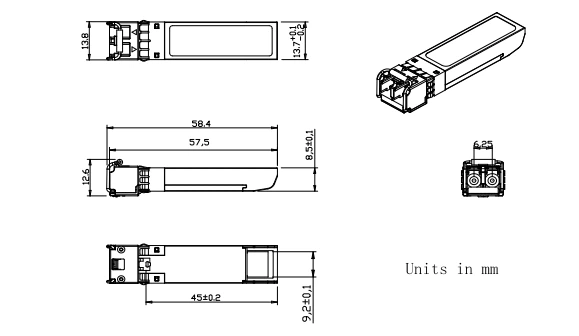
Pin Assignment

DDM

Fully compatible

In today's rapidly evolving data center and enterprise network landscape, selecting the right Optical Transceivers is crucial for optimal network performance. This comprehensive guide explores an enterprise-grade 10G SFP+ long-range transmission solution, helping you understand how to choose the best optical communication equipment for your network infrastructure.
Understanding SFP+ Optical Transceivers
SFP+ (Small Form-factor Pluggable Plus) represents the next generation of Optical Transceivers standards, specifically designed for high-speed data transmission. These optical modules feature hot-swappable design, allowing replacement without powering down equipment, significantly enhancing network maintenance efficiency. Compared to traditional optical modules, SFP+ offers smaller form factors, lower power consumption, while maintaining exceptional transmission performance.
Core Product Advantages
Long-Distance Transmission Capability
This optical module supports single-mode fiber transmission up to 10 kilometers, making it ideal for:
Campus network interconnection
Inter-data center connectivity
Metropolitan area network access
Building-to-building communications
Operating at the 1310nm wavelength, it achieves low-loss transmission over single-mode fiber, ensuring stable and reliable signal quality.
Industrial-Grade Reliability
With an extended operating temperature range from 0 to 70°C, these Optical Transceivers adapt to various deployment environments, from climate-controlled server rooms to industrial sites. This design is particularly suitable for:
Outdoor cabinet deployments
Industrial Ethernet applications
Environments with temperature fluctuations
Network nodes without precision air conditioning
Intelligent Digital Diagnostics
Integrated DDM (Digital Diagnostics Monitoring) functionality provides real-time monitoring of:
Transmit optical power
Receive optical power
Operating temperature
Supply voltage
Laser bias current
These parameters enable network administrators to identify potential issues proactively, implementing preventive maintenance strategies.
Technical Specifications Explained
Optical Performance
The optical design of these Optical Transceivers has been meticulously optimized. With a transmit power range between -6.0 and -1.0dBm, it ensures sufficient signal strength to traverse 10-kilometer fiber spans. The receiver sensitivity better than -12.6dBm enables reliable data reception even on links with significant signal attenuation.
Interface and Compatibility
Featuring standard duplex LC connectors, the industry's most common optical interface type, offering:
High-density port deployment capability
Excellent insertion/extraction durability
Low insertion loss
Superior interchangeability
Fully compatible with mainstream switches and routers, supporting Multi-Source Agreement (MSA) standards from leading network equipment manufacturers.
Transmission Rate
Supporting 10Gbps full-duplex transmission, these modules meet requirements for:
High-definition video streaming
Large-scale data backup operations
Virtualized environments
Cloud computing access
Storage Area Networks (SAN)
Application Scenarios
Enterprise Data Centers
In data center architectures, these Optical Transceivers are commonly used for:
Access-to-aggregation layer connections
Server uplinks
Storage network interconnection
Disaster recovery center connectivity
Telecom Carrier Networks
Carriers can deploy them in:
Metropolitan area network aggregation nodes
Enterprise dedicated line access
Base station backhaul
5G fronthaul networks
Smart Campus
In large campus networks, they enable:
High-speed building interconnection
Surveillance system transmission backbone
Wireless AP controller connectivity
Unified communications platform interconnection
Deployment Best Practices
Fiber Selection
For 10-kilometer transmission distances, G.652.D standard single-mode fiber is recommended. Ensure fiber cleanliness by using professional cleaning tools to treat end faces, preventing dust from affecting transmission quality.
Link Budget
When designing networks, consider:
Fiber attenuation (approximately 0.35dB/km)
Connector loss (approximately 0.3dB each)
Splice loss (approximately 0.1dB each)
System margin (minimum 3dB recommended)
Maintenance Recommendations
Regularly monitor DDM parameters and establish baseline values. When optical power anomalies are detected, promptly inspect fiber connections and cleanliness.
Comparison with Other Optical Transceivers
Compared to short-range SFP+ modules, long-range versions utilize higher-quality lasers and receivers, with slightly higher costs but significantly extended transmission distances. Versus 40G/100G high-speed Optical Transceivers, 10G solutions offer lower costs, making them suitable for moderate bandwidth requirement scenarios.
Frequently Asked Questions (FAQ)
Q1: Are these optical modules compatible with other brand equipment? A: Yes, these products comply with IEEE 802.3ae and SFF-8431 standards, offering full compatibility with mainstream vendor equipment including Cisco, Huawei, Juniper, and Arista. We recommend confirming that your equipment supports third-party optical modules before procurement.
Q2: Is 10 kilometers a theoretical or actual achievable distance? A: 10 kilometers represents the actual achievable distance on standard single-mode fiber (G.652.D) under normal operating conditions. In actual deployments, a 3-5dB system margin should be reserved to ensure long-term stable operation.
Q3: Does DDM functionality require special software support? A: Most enterprise-grade network equipment natively supports DDM functionality, accessible through command-line interfaces or network management software. No additional software installation is required, though you should confirm your equipment firmware version supports this feature.
Q4: Is optical module heating normal? Is additional cooling needed? A: Heat generation during operation is normal. As long as operating within the specified temperature range (0-70°C), no additional cooling is necessary. Ensure equipment chassis ventilation is adequate and avoid prolonged operation in enclosed spaces.
Q5: How can I determine if an optical module is functioning properly? A: Verify through: 1) Normal equipment port indicator lights; 2) DDM parameters within reasonable ranges; 3) Successful link establishment; 4) Bit error rate within acceptable limits (typically below 10^-12).
Q6: What's the difference between single-mode and multi-mode fiber? Can this product use multi-mode fiber? A: Single-mode fiber has a smaller core diameter (approximately 9 microns), enabling longer transmission distances but at higher cost; multi-mode fiber has a larger core (50 or 62.5 microns), suitable for short-distance transmission. This product is designed for single-mode fiber and is not recommended for multi-mode fiber use, as it will not achieve specified distances.
Q7: What is the lifespan of optical modules? A: Under normal operating conditions, high-quality Optical Transceivers can last 7-10 years. Actual lifespan is influenced by operating temperature, insertion/extraction cycles, and power quality. Annual DDM parameter trend analysis is recommended.
Q8: Why is LC interface recommended over SC interface? A: LC interfaces are more compact, allowing more ports in the same panel space, particularly suitable for high-density deployments. Insertion/extraction operations are more convenient, and current mainstream equipment predominantly uses LC interfaces, facilitating unified management.
Q9: Can these modules be used in harsh industrial environments? A: Yes, the wide operating temperature range makes them suitable for industrial applications. However, ensure the environment stays within specified limits and provide adequate protection against dust, moisture, and vibration.
Q10: What's the difference between DDM and DOM? A: DDM (Digital Diagnostics Monitoring) and DOM (Digital Optical Monitoring) are essentially the same feature with different terminology. Both provide real-time monitoring of optical module performance parameters.
Conclusion
Selecting appropriate Optical Transceivers is a critical step in building high-performance networks. The 10G SFP+ long-range optical module discussed in this guide offers an ideal solution for enterprise networks, data centers, and carrier applications through its exceptional transmission performance, reliable industrial design, and intelligent monitoring capabilities.
In today's accelerating digital transformation era, investing in high-quality Optical Transceivers not only meets current bandwidth demands but also reserves capacity for future network expansion. Through proper planning, correct deployment, and regular maintenance, these optical communication devices will become the most reliable component of your network infrastructure.
When evaluating Optical Transceivers for your specific needs, consider factors such as transmission distance requirements, environmental conditions, budget constraints, and future scalability. This holistic approach ensures you select modules that deliver optimal performance and value for your organization's unique requirements.
Hot Tags: 10g sfp+ 10km lr, China 10g sfp+ 10km lr suppliers, manufacturers, factory


