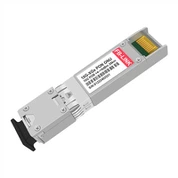
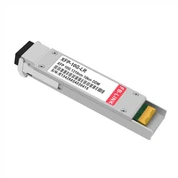
10G BIDI SFP+ 40KM
10G SFP+ BIDI 40KM is a pair of 10Gbps SFP+ BiDi transceivers, transmitted through single-mode optical fiber, with a distance of up to 40km.

- Product Introduction
Features
-
Hot-swappable SFP+ package
-
Single LC for Bi-‐directional Transmission
-
Built-‐in digital diagnostic functions
-
Compliant with IEEE 802.3ae
-
Compliant with SFP+ MSA
-
Power dissipation 1.5W
-
Temperature range 0°C to 70°C
Appliacation

Server

Network card

Firewall

Media converter
Specification
| Form Factor | SFP+ | Fiber Type | SMF |
| Wavelength | 1270nm-TX/1330nm-RX | Max Distance | 40 km |
| TX Power | 0~+4dBm | Connector | LC |
| Receiver Sensitivity | <-15dBm | Commercial Temperature Range | 0 to 70°C |
| DDM/DOM | Supported | Warranty | 3 Years |
Fully compatible

Certificate


Shipping method

Air transport

Ocean shipping

Land transportation
Network administrators and IT professionals continually seek reliable solutions to meet growing bandwidth demands across data centers and enterprise networks. Optical transceivers have emerged as critical components that enable high-speed data transmission over fiber optic cables, bridging the gap between networking equipment and physical fiber infrastructure.
What Makes Modern Optical Transceivers Essential?
The evolution of network technology has placed unprecedented demands on data transmission capabilities. Optical transceivers serve as the foundation for these high-speed connections, converting electrical signals into optical signals for transmission and vice versa. These compact modules have become indispensable in building scalable, efficient network architectures.
Key Advantages of Advanced Optical Transceivers
Modern optical transceivers deliver several performance benefits that directly impact network reliability and efficiency:
Hot-Swappability for Maximum Uptime - The ability to replace modules without powering down equipment means network maintenance can occur without disrupting critical operations. This feature proves invaluable in environments where downtime translates to significant business losses.
Bi-Directional Technology - Single-fiber bi-directional transmission represents a significant advancement in optical transceivers, utilizing different wavelengths for transmitting and receiving data over a single fiber strand. This approach reduces fiber infrastructure costs while maintaining high performance levels.
Intelligent Monitoring Capabilities - Built-in digital diagnostic functions allow network administrators to monitor real-time performance metrics including temperature, voltage, laser bias current, and optical power levels. This proactive monitoring helps prevent failures before they occur.
Technical Considerations for Optical Transceivers Selection
Selecting appropriate optical transceivers requires understanding several critical specifications that impact performance and compatibility.
Distance and Wavelength Specifications
Long-reach applications demand optical transceivers capable of spanning significant distances without signal degradation. Solutions supporting 40-kilometer transmission over single-mode fiber address the needs of metropolitan area networks and campus connectivity. The wavelength selection, typically in the 1270nm to 1330nm range for bi-directional modules, optimizes signal integrity across these distances.
Power Management and Thermal Performance
Energy efficiency remains paramount in modern data centers. Optical transceivers with optimized power consumption, typically around 1.5W, contribute to reduced operational costs and simplified cooling requirements. Operating temperature ranges from 0°C to 70°C ensure reliable performance across diverse environmental conditions.
Industry Standards Compliance
Adherence to established standards like IEEE 802.3ae and SFP+ Multi-Source Agreement (MSA) guarantees optical transceivers will integrate seamlessly with equipment from multiple vendors. This standardization protects infrastructure investments and provides flexibility in network design.
Optimizing Network Performance with Optical Transceivers
Implementing optical transceivers effectively requires attention to several deployment considerations:
Signal Quality Parameters - Transmission power levels between 0 to +4dBm paired with receiver sensitivity better than -15dBm provide substantial link budget margin, ensuring stable connections even in challenging installations.
Connector Compatibility - LC connector interfaces have become the standard for optical transceivers, offering high density and reliable performance in space-constrained environments.
Future-Proofing Investments - Extended warranty coverage, often up to three years, demonstrates manufacturer confidence while protecting against premature failures.
Application Scenarios for High-Performance Optical Transceivers
Optical transceivers find application across diverse networking environments:
Data Center Interconnects - Connecting server racks and storage arrays with high-bandwidth, low-latency links
Enterprise Campus Networks - Extending fiber connectivity across building complexes
Metropolitan Area Networks - Bridging locations within city-wide deployments
Telecommunications Infrastructure - Supporting carrier-grade service delivery
Frequently Asked Questions
Q: How do I know if optical transceivers are compatible with my existing network equipment?
A: Check that the optical transceivers comply with industry standards like SFP+ MSA and IEEE specifications matching your equipment requirements. Most enterprise networking gear from major vendors supports standards-compliant modules. Always verify the transceiver form factor (SFP+, QSFP+, etc.) matches your switch or router ports.
Q: What is the significance of DDM/DOM support in optical transceivers?
A: Digital Diagnostic Monitoring (DDM) or Digital Optical Monitoring (DOM) enables optical transceivers to provide real-time performance data. This allows network administrators to monitor signal strength, temperature, and other vital parameters, facilitating predictive maintenance and faster troubleshooting.
Q: Can optical transceivers work with different fiber types?
A: Optical transceivers are designed for specific fiber types - either single-mode fiber (SMF) or multi-mode fiber (MMF). Single-mode versions support longer distances, while multi-mode variants are optimized for shorter reaches. Always match the transceiver type to your installed fiber infrastructure.
Q: What does bi-directional transmission mean for optical transceivers?
A: Bi-directional optical transceivers use different wavelengths to transmit and receive data simultaneously over a single fiber strand. This technology reduces fiber requirements by half compared to traditional dual-fiber implementations, lowering infrastructure costs significantly.
Q: How important is the operating temperature range for optical transceivers?
A: Operating temperature specifications determine where optical transceivers can be reliably deployed. Commercial-grade modules (0-70°C) suit controlled environments like data centers, while industrial-grade versions handle harsher conditions. Deploying transceivers outside their rated temperature range can cause performance degradation or failure.
Q: What maintenance do optical transceivers require?
A: Optical transceivers require minimal maintenance, but regular cleaning of fiber connectors is essential. Dust and contaminants can significantly degrade signal quality. Additionally, monitoring diagnostic data helps identify potential issues before they cause outages. Always follow proper handling procedures to prevent electrostatic discharge damage.
Q: How does link budget affect optical transceiver performance?
A: Link budget represents the difference between transmit power and receiver sensitivity in optical transceivers. A larger budget provides margin for signal loss through fiber, connectors, and splices. Always calculate total system loss and ensure adequate budget margin for reliable long-term operation.
Hot Tags: Optical Transceivers
You Might Also Like