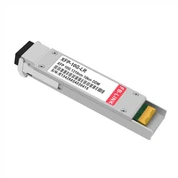
10Gb/s SR 300m SFP+
10Gb/s Duplex LC, MMF, 850nm VCSEL-LD, PIN Receiver, SR 300m SFP+ Transceiver Features: 1 Support multi-protocol from 8.5Gb/s to 11.3Gb/s 2 Hot-Pluggable SFP+ footprint 3 850nm VCSEL laser transmitter 4 Duplex LC connector 5 Up to 300m links on MMF OM3 6 Single +3.3V Power Supply 7 Power...

- Product Introduction
Absolute Maximum Ratings
| Parameter | Symbol | Min. | Typical | Max. | Unit |
| Storage Temperature | Ts | -40 | +85 | ℃ | |
| Case Operating Temperature | Ta | 0 | 70 | ℃ | |
| Supply Voltage | Vcc | -0.5 | 3.6 | V | |
| Relative Humidity | RH | 0 | 85 | % | |
|
Industrial
|
TC | -40 | +85 | ℃ | |
|
Commercial
|
TC | 0 | 70 | ℃ |
Understanding Optical Transceivers: Your Complete Guide to High-Performance Data Transmission
The backbone of modern network infrastructure relies heavily on advanced communication components. Optical transceivers serve as critical elements that enable seamless data transmission across fiber optic networks, converting electrical signals into optical signals and vice versa. Whether you're building a data center, upgrading enterprise networks, or designing telecommunications systems, understanding these components is essential for optimal performance.
What Makes Optical Transceivers Essential for Modern Networks?
Optical transceivers function as the bridge between electronic equipment and fiber optic cables. These compact modules handle bidirectional communication, transmitting and receiving data simultaneously. Their importance has grown exponentially as bandwidth demands continue to surge across industries.
The technology behind optical transceivers combines sophisticated laser diodes for transmission and photodiodes for reception, all housed in standardized form factors. This integration allows network administrators to achieve high-speed connectivity while maintaining flexibility in network design.
Key Performance Specifications to Consider
When evaluating optical transceivers, environmental resilience stands as a crucial factor. Quality modules are engineered to withstand extreme conditions, operating reliably across wide temperature ranges. Industrial-grade solutions typically function from sub-zero temperatures extending well into high-heat environments, while commercial variants are optimized for controlled settings.
Power efficiency represents another critical consideration. Modern optical transceivers operate within carefully controlled voltage parameters, ensuring stable performance without excessive energy consumption. This efficiency translates directly into reduced operational costs and enhanced system reliability.
Humidity tolerance also plays a vital role in deployment scenarios. Premium optical transceivers maintain consistent performance even in moisture-rich environments, preventing signal degradation and extending component lifespan.
Applications Across Industries
Optical transceivers find applications in diverse sectors:
Data Centers utilize these modules to interconnect servers, storage systems, and networking equipment, enabling rapid data exchange essential for cloud computing and virtualization platforms.
Telecommunications Networks depend on optical transceivers for long-haul transmission, metropolitan area networks, and last-mile connectivity solutions that bring high-speed internet to end users.
Enterprise Networks deploy these components to build robust campus networks, connect multiple building locations, and support bandwidth-intensive applications like video conferencing and real-time collaboration.
Industrial Automation leverages ruggedized optical transceivers in manufacturing facilities, power plants, and transportation systems where reliability under harsh conditions is non-negotiable.
Selecting the Right Solution
Choosing appropriate optical transceivers requires careful assessment of your specific requirements. Consider the operating environment first-will the modules function in climate-controlled spaces or face temperature extremes? This determination guides whether commercial or industrial-rated solutions are necessary.
Distance requirements significantly influence selection. Different optical transceivers support varying transmission distances, from short-reach applications within a single building to long-haul connections spanning hundreds of kilometers.
Compatibility verification ensures seamless integration with existing infrastructure. Modern optical transceivers adhere to industry standards, but confirming compatibility with switches, routers, and fiber types prevents costly deployment issues.
Future-Proofing Your Network Investment
As network demands evolve, optical transceivers continue advancing in speed and efficiency. Investing in quality components with robust environmental specifications ensures your infrastructure remains viable as requirements grow. The ability to operate across extended temperature ranges and varying humidity levels provides deployment flexibility that adapts to changing needs.
Frequently Asked Questions
What is the difference between commercial and industrial optical transceivers?
Commercial optical transceivers are designed for controlled environments like data centers and office buildings, typically operating within moderate temperature ranges. Industrial versions withstand extreme conditions, functioning reliably in harsh environments with wider temperature tolerances and enhanced durability for manufacturing, outdoor, or utility applications.
How does temperature affect optical transceiver performance?
Temperature directly impacts optical transceivers performance by influencing laser output power, receiver sensitivity, and overall signal quality. Quality modules incorporate thermal management features and are rated for specific temperature ranges, ensuring consistent operation whether deployed in air-conditioned facilities or challenging industrial settings.
What should I consider regarding power requirements?
Optical transceivers require stable power delivery within specified voltage ranges. Exceeding voltage limits can damage components, while insufficient power causes transmission errors. Understanding power specifications ensures proper system design with adequate power budgets and protection mechanisms.
Can optical transceivers operate in high-humidity environments?
Premium optical transceivers are engineered to function reliably in elevated humidity conditions without performance degradation. Humidity resistance prevents moisture-related issues like corrosion and condensation that could compromise signal integrity. Always verify humidity ratings match your deployment environment.
How long do optical transceivers typically last?
When operated within specified parameters, optical transceivers deliver years of reliable service. Lifespan depends on environmental conditions, power quality, and thermal management. Modules deployed in stable, controlled environments with proper cooling generally outlast those exposed to temperature extremes and humidity cycling.
Are all optical transceivers compatible with any network equipment?
While optical transceivers follow industry standards, compatibility verification remains essential. Factors like data rate, wavelength, connector type, and manufacturer-specific coding affect interoperability. Always confirm compatibility with your specific switches, routers, and fiber infrastructure before deployment.
What maintenance do optical transceivers require?
Optical transceivers need minimal maintenance when properly installed. Regular monitoring of operating parameters, keeping connectors clean, ensuring adequate ventilation, and verifying secure seating in ports helps maintain optimal performance. Periodic inspection detects potential issues before they impact network operations.
Hot Tags: 10gb/s sr 300m sfp+, China 10gb/s sr 300m sfp+ suppliers, manufacturers, factory