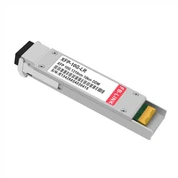
10G EPON ONU 20km
The module integrates a 10Gb/s 1270nm burst mode transmitter and a 10Gb/s 1577nm continuous mode receiver.

- Product Introduction
Item Spotlights
● Integrated Single fiber bi-directional optical subassembly
● Symmetric 9.953Gb/s upstream and downstream bit rate
● SFP+ metallic package,SC connector
● +3.3V single power supply
● Low power consumption
● 0 to 70°C operating case temperature
● Class 1 Laser eye safety
● Excellent EMI and EMC characteristics
● Compliant with RoHS&WEEE
Absolute Maximum Ratings
|
Parameter |
Unit |
Min |
Max |
|
Operating ambient Temperature Range |
℃ |
0 |
70 |
|
Storage Temperature Range |
℃ |
-40 |
85 |
|
Relative Humidity |
% |
5 |
95 |
|
Power Supply Voltage |
V |
0 |
4.6 |
|
Pin Input Voltage |
V |
GND |
Vcc |
|
Reciever Damage Threshold |
dBm |
-9 |
- |
Block Diagram

The evolution of data transmission technology has revolutionized how businesses handle massive information flows. As network demands continue to surge, Optical Transceivers have emerged as critical components enabling high-speed, reliable connectivity across diverse applications. These sophisticated devices bridge the gap between electrical and optical signals, making them indispensable for modern telecommunications infrastructure.
What Makes Advanced Optical Transceivers Essential?
Optical Transceivers serve as the backbone of fiber optic communication systems, converting electrical signals into optical ones for transmission and vice versa. The latest generation of these devices offers unprecedented performance levels, particularly in metropolitan area networks, data centers, and enterprise environments requiring robust, high-bandwidth connections.
Modern single-fiber bi-directional Optical Transceivers represent a significant advancement in network efficiency. By utilizing a single fiber strand for both upstream and downstream transmission, these devices dramatically reduce infrastructure costs while maintaining exceptional performance standards. This bi-directional capability proves especially valuable in scenarios where fiber resources are limited or expensive to deploy.
Key Performance Characteristics of Professional-Grade Optical Transceivers
When evaluating Optical Transceivers for enterprise deployment, several critical factors determine their suitability for demanding applications. Symmetric data transmission capabilities ensure balanced performance, with identical speeds for both sending and receiving data-a crucial requirement for applications like video conferencing, cloud computing, and real-time data synchronization.
The SFP+ form factor has become an industry standard for Optical Transceivers, offering hot-swappable functionality that minimizes network downtime during maintenance or upgrades. This metallic package design provides superior electromagnetic interference protection, ensuring signal integrity even in electrically noisy environments.
Power efficiency represents another vital consideration in modern network design. Contemporary Optical Transceivers operate on standard power supplies while maintaining remarkably low consumption levels, contributing to reduced operational costs and environmental sustainability. This efficiency becomes particularly significant in large-scale deployments where hundreds or thousands of transceivers operate simultaneously.
Operating Environments and Reliability Standards
Professional Optical Transceivers must perform reliably across varying environmental conditions. Industrial-grade devices maintain consistent operation across wide temperature ranges, making them suitable for deployment in equipment rooms without extensive climate control. This temperature tolerance ensures reliable performance whether installed in temperature-controlled data centers or less regulated telecommunications closets.
Humidity resistance adds another layer of reliability, allowing Optical Transceivers to function properly in diverse climates and conditions. This robustness proves essential for installations in coastal regions, tropical environments, or areas with significant seasonal weather variations.
Safety and Compliance Considerations
Eye safety remains paramount when working with Optical Transceivers. Class 1 laser classification indicates the highest level of safety, meaning the devices pose no risk to human vision under normal operating conditions. This classification allows technicians to work confidently with the equipment during installation and maintenance procedures.
Environmental compliance has become increasingly important in technology procurement. Modern Optical Transceivers adhere to international environmental standards, including RoHS (Restriction of Hazardous Substances) and WEEE (Waste Electrical and Electronic Equipment) directives. These certifications ensure responsible manufacturing practices and facilitate proper end-of-life disposal.
Electromagnetic Compatibility for Sensitive Environments
Superior electromagnetic interference (EMI) and electromagnetic compatibility (EMC) characteristics distinguish premium Optical Transceivers from standard offerings. These properties ensure the devices neither emit excessive electromagnetic radiation nor succumb to interference from surrounding equipment. Such performance proves critical in healthcare facilities, financial institutions, and other environments with sensitive electronic systems.
Application Scenarios for Advanced Optical Transceivers
Optical Transceivers find applications across numerous industries and use cases. Metropolitan area networks leverage their capabilities to connect distributed office locations with high-speed, reliable links. Data centers utilize these devices to create high-density interconnections between servers, storage systems, and networking equipment.
Telecommunications providers deploy Optical Transceivers extensively in fiber-to-the-premises applications, delivering high-speed internet services to residential and business customers. The single-fiber bi-directional design proves particularly economical in these scenarios, maximizing the utility of existing fiber infrastructure.
Frequently Asked Questions About Optical Transceivers
Q: What is the difference between bi-directional and traditional optical transceivers?
Bi-directional Optical Transceivers use a single fiber strand for both transmission and reception by utilizing different wavelengths for each direction. Traditional transceivers require separate fibers for transmit and receive functions. Bi-directional designs reduce fiber requirements by half, significantly lowering infrastructure costs.
Q: How do I ensure compatibility when selecting optical transceivers for my network?
Compatibility depends on several factors: the form factor (such as SFP+), data rate specifications, wavelength requirements, and fiber type. Always verify that Optical Transceivers match your equipment's specifications and network architecture. Consulting manufacturer compatibility matrices helps ensure seamless integration.
Q: What maintenance do optical transceivers require?
Optical Transceivers require minimal maintenance but benefit from periodic cleaning of optical connectors, monitoring of performance parameters, and ensuring adequate ventilation around installed devices. Regular firmware updates, when available, can enhance performance and security.
Q: Can optical transceivers operate in harsh environmental conditions?
Professional-grade Optical Transceivers are designed to function reliably across specified temperature and humidity ranges. However, extreme conditions beyond rated specifications may require additional environmental controls or specialized industrial-grade variants designed for harsh environments.
Q: What factors affect the transmission distance of optical transceivers?
Transmission distance for Optical Transceivers depends on wavelength, fiber type (single-mode or multi-mode), fiber quality, connection quality, and the receiver's sensitivity threshold. Each transceiver model specifies maximum distance capabilities under optimal conditions.
Q: How does power consumption impact optical transceiver selection?
Power consumption affects operating costs, heat generation, and power supply requirements. Lower power Optical Transceivers reduce electricity costs in large deployments, minimize cooling requirements, and allow higher port density in networking equipment.
Q: What does RoHS compliance mean for optical transceivers?
RoHS compliance means Optical Transceivers are manufactured without hazardous substances like lead, mercury, and cadmium. This certification ensures environmental responsibility and may be required for procurement in certain jurisdictions or industries.
Optimizing Network Performance with the Right Optical Transceivers
Selecting appropriate Optical Transceivers requires careful consideration of current needs and future scalability. Symmetric data rates ensure balanced performance for modern applications requiring equal upstream and downstream bandwidth. The ability to hot-swap components without network interruption provides operational flexibility crucial for maintaining service availability.
Understanding the total cost of ownership extends beyond initial purchase price. Energy-efficient Optical Transceivers deliver long-term savings through reduced power consumption, while reliable components minimize replacement costs and network downtime. Environmental compliance ensures responsible technology stewardship and regulatory adherence.
As network demands continue evolving, Optical Transceivers remain at the forefront of enabling high-speed, reliable communications infrastructure. Their combination of performance, efficiency, and reliability makes them indispensable components in modern networking environments, supporting everything from enterprise connectivity to telecommunications services that power our increasingly connected world.
Hot Tags: Optical Transceivers
You Might Also Like