





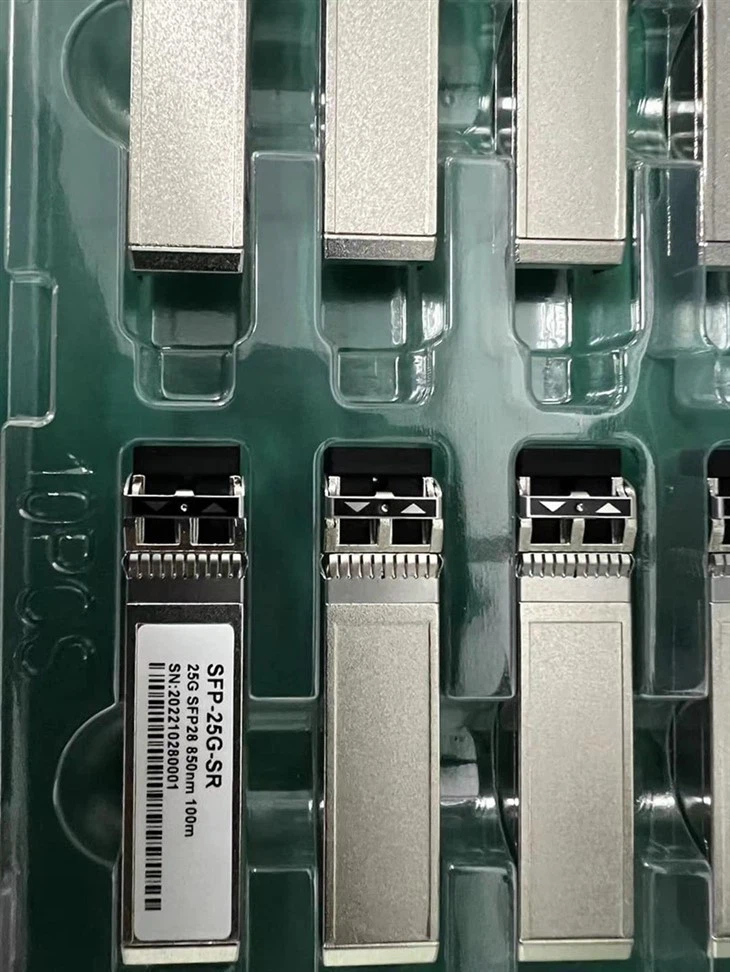
25G SR SFP28
25G SR SFP28 uses multimode fiber (MMF) to transmit data at 25 gigabits per second (Gbps). It supports link distances of up to 100 meters, making it ideal for connecting devices within data centers.

- Product Introduction
Physical picture

Ccompatible

Products Description
| Form Factor | SFP28 | Operating Voltage | 3.3V |
| Rate | 25GB/S | TX Power | -7.0~-2.4dBm |
| Reach | 100M | Receiver Sensitivity | <-10.3dBm |
| Wave | 850nm | DDM |
YES
|
Certificate


The rapid evolution of network infrastructure has placed unprecedented demands on data transmission equipment. Optical transceivers serve as critical components that enable high-speed data transfer across fiber optic networks, converting electrical signals into optical signals and vice versa. These compact modules have become indispensable in data centers, telecommunications networks, and enterprise connectivity solutions.
What Makes Optical Transceivers Essential?
Optical transceivers function as the interface between electronic networking equipment and fiber optic cables. By leveraging light wavelengths to transmit data, these devices achieve speeds and distances impossible with traditional copper-based solutions. Modern implementations support various form factors and performance specifications, each designed for specific network requirements.
Short-reach applications particularly benefit from multi-mode fiber solutions operating at wavelengths optimized for cost-effective performance. These configurations excel in environments where equipment sits within the same building or campus, delivering exceptional bandwidth without the expense of long-distance components.
Key Performance Characteristics
When evaluating optical transceivers, several parameters determine their suitability for specific deployments. Transmission rates define the data throughput capacity, with contemporary solutions supporting everything from legacy gigabit speeds to cutting-edge multi-gigabit performance. The distance capability indicates maximum reliable transmission reach, while power specifications ensure compatibility with host equipment.
Signal quality metrics play an equally vital role. Transmit power levels must fall within acceptable ranges to prevent overwhelming receivers while maintaining sufficient strength for error-free communication. Receiver sensitivity thresholds establish the minimum detectable signal power, directly impacting link budget calculations and maximum achievable distances.
Advanced Monitoring Capabilities
Digital Diagnostics Monitoring (DDM) represents a significant advancement in optical transceivers technology. This feature enables real-time monitoring of critical parameters including temperature, voltage, transmit power, receive power, and laser bias current. Network administrators leverage this diagnostic data to predict potential failures, optimize performance, and reduce downtime through proactive maintenance.
The availability of DDM transforms optical transceivers from passive transmission components into intelligent network elements. This visibility proves invaluable for troubleshooting connectivity issues, verifying link quality, and ensuring compliance with network performance standards.
Application Scenarios
Optical transceivers find deployment across diverse networking environments. Data center interconnects rely on these modules to create high-bandwidth connections between servers, switches, and storage arrays. The combination of high density and low power consumption makes them ideal for space-constrained equipment racks where cooling capacity is limited.
Enterprise networks leverage optical transceivers to extend connectivity beyond the limitations of copper cabling. Campus backbones, building-to-building links, and distribution layer aggregation all benefit from the electromagnetic interference immunity and security advantages inherent to fiber optic transmission.
Installation and Compatibility Considerations
Successful deployment of optical transceivers requires attention to several compatibility factors. The physical form factor must match available ports on networking equipment, ensuring proper mechanical and electrical interfaces. Protocol support verification prevents communication mismatches that could degrade performance or prevent link establishment.
Fiber type compatibility represents another critical consideration. Multi-mode fiber solutions optimize cost and performance for shorter distances, while single-mode variants excel in long-haul applications. Matching the transceiver wavelength to fiber characteristics ensures optimal transmission efficiency and minimizes signal degradation.
Future-Proofing Network Infrastructure
Selecting the right optical transceivers involves balancing current requirements against future scalability needs. Upgrading to higher-speed modules often requires only transceiver replacement rather than complete infrastructure overhauls, provided the fiber plant supports the enhanced specifications.
Standards compliance ensures interoperability across multi-vendor environments. Industry specifications from organizations like IEEE and MSA define electrical, optical, and mechanical parameters that enable seamless integration regardless of manufacturer. This standardization protects infrastructure investments while maintaining flexibility in vendor selection.
Frequently Asked Questions
Q: What is the difference between optical transceivers and copper transceivers?
A: Optical transceivers convert electrical signals to light for transmission over fiber optic cables, enabling much longer distances and higher speeds compared to copper transceivers. They're immune to electromagnetic interference and provide enhanced security since fiber doesn't emit detectable signals. Copper transceivers are limited to shorter distances (typically under 100 meters) but cost less for very short connections.
Q: How do I know if optical transceivers are compatible with my networking equipment?
A: Verify three key factors: the form factor (SFP, SFP+, SFP28, QSFP28, etc.) matches your equipment's port type, the data rate aligns with your network speed requirements, and the fiber type (single-mode or multi-mode) corresponds to your cabling infrastructure. Most manufacturers provide compatibility matrices for their equipment.
Q: What does DDM mean and why is it important in optical transceivers?
A: Digital Diagnostics Monitoring in optical transceivers provides real-time visibility into module performance metrics. It allows network administrators to monitor temperature, optical power levels, and other critical parameters without specialized test equipment. This capability enables proactive maintenance, faster troubleshooting, and prevention of unexpected network failures.
Q: Can optical transceivers be hot-swapped?
A: Yes, most modern optical transceivers support hot-swapping, meaning they can be installed or removed while the host equipment remains powered on. This feature minimizes network downtime during upgrades or replacements. However, always consult your equipment documentation to confirm hot-swap support before attempting field replacements.
Q: What factors affect the maximum distance optical transceivers can achieve?
A: Several factors influence reach: the transceiver's transmit power and receiver sensitivity, fiber type and quality, wavelength used, connector quality, and the number of patch panels or splices in the link. Clean fiber connections and proper cable management significantly impact achievable distances. Link budget calculations help determine if a specific combination will reliably support your required distance.
Q: Do optical transceivers require special handling or storage?
A: Optical transceivers are sensitive to dust, contamination, and electrostatic discharge. Always keep protective dust caps on unused ports, handle modules by their edges, and use proper ESD precautions. Store spare units in anti-static packaging in temperature-controlled environments. Never look directly into active fiber ports as the laser light can damage eyesight.
Hot Tags: Optical Transceivers
You Might Also Like


