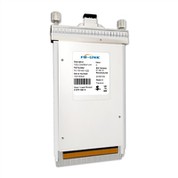
40G QSFP+ LR4
40G QSFP+ LR4 1310nm 10km DOM Duplex LC SMF Optical Transceiver Module Products Description The QSFP+ module is designed for use in 40GBASE Ethernet throughput up to 10km over single mode fiber (SMF) using a wavelength of 1310nm via duplex LC connectors. This transceiver is compliant with QSFP+...

- Product Introduction
Technical Specifications
| Compatible | 40GE QSFP+ LR4 | TX Power | -7~2.3dBm |
| Wavelength | 1310nm | Receiver Sensitivity | <-11dBm |
| Connector | Duplex LC | Transimitter Type | DFB CWDM |
| Max Data Rate | 44.6Gbps (4x 11.2Gbps) | Receiver Type | PIN |
| Max Cable Distance | 10km | Media | SMF |
Technical Specifications
The advantages of the 40G QSFP+LR4 module you have chosen are::
-
Single +3.3V power supply operating
-
4 CWDM lanes MUX/DEMUX design
-
Compliant with QDR/DDR Infiniband data rates
-
Up to 11.2Gbps per channel bandwidth
-
Temperature range 0°C to 70°C
-
Compliant with 40G Ethernet IEEE802.3ba and 40GBASE-LR4 Standard
-
RoHS Compliant Part

Application scenario

Fully Compatible

Certificate


The demand for high-bandwidth network infrastructure continues to grow exponentially as businesses scale their data center operations and cloud services. Among the various optical transceivers available, the 40G QSFP+ LR4 module stands out as a robust solution for long-reach applications requiring exceptional performance and reliability.
What Makes 40G QSFP+ LR4 Optical Transceivers Essential for Modern Networks
When selecting optical transceivers for enterprise networks, the 40G QSFP+ LR4 module offers a compelling combination of distance capability and multi-lane architecture. This transceiver leverages Coarse Wavelength Division Multiplexing (CWDM) technology across four independent lanes, each operating at 11.2Gbps, to achieve an aggregate throughput of 44.6Gbps.
The module operates at the 1310nm wavelength band using DFB CWDM transmitters paired with PIN photodetectors, enabling reliable data transmission over single-mode fiber up to 10 kilometers. This makes it ideal for campus network interconnects, metropolitan area networks, and data center-to-data center links where extended reach is crucial.
Key Performance Characteristics
The engineering behind these optical transceivers prioritizes both efficiency and compliance. Operating on a simple 3.3V power supply, the module maintains a thermal envelope suitable for standard operating environments ranging from 0°C to 70°C. The optical budget is carefully designed with transmit power between -7 and 2.3dBm, while the receiver maintains sensitivity better than -11dBm, ensuring consistent link performance.
Full compliance with IEEE 802.3ba standards and the 40GBASE-LR4 specification guarantees interoperability across multi-vendor environments. Additionally, QDR and DDR InfiniBand compatibility extends the module's utility beyond traditional Ethernet applications into high-performance computing scenarios.
Advantages of CWDM-Based Architecture in Optical Transceivers
The four-lane MUX/DEMUX design represents a significant advantage in modern optical transceivers. By separating the 40G signal into four parallel 10G streams using different wavelengths, this architecture provides several benefits:
Enhanced Reliability: If a single lane experiences degradation, the link can potentially operate at reduced capacity rather than complete failure, depending on the system's forward error correction capabilities.
Simplified Fiber Infrastructure: The duplex LC connector interface utilizes just two fiber strands, minimizing fiber consumption compared to parallel optics solutions that require 8 or 12 fibers.
Cost-Effective Scaling: For organizations upgrading from 10G infrastructure, the familiar wavelength plan and fiber type allow for seamless migration without complete infrastructure replacement.
Environmental Responsibility in Optical Transceivers
Modern optical transceivers must meet stringent environmental standards. RoHS compliance ensures that these modules are manufactured without hazardous substances, aligning with global sustainability initiatives and regulatory requirements across different markets.
Frequently Asked Questions
Q: What is the maximum distance supported by 40G QSFP+ LR4 optical transceivers?
A: These modules support transmission distances up to 10 kilometers over standard single-mode fiber, making them suitable for long-reach applications within campus networks and metro deployments.
Q: Can I use these optical transceivers with existing 10G infrastructure?
A: While the physical fiber infrastructure (single-mode fiber) is compatible, you cannot directly connect a 40G module to 10G equipment. However, the same fiber plant can be reused when upgrading switches and optical transceivers to 40G.
Q: What's the difference between LR4 and SR4 optical transceivers?
A: LR4 (Long Reach) uses single-mode fiber and operates at 1310nm for distances up to 10km, while SR4 (Short Reach) uses multimode fiber with 850nm optics for distances up to 150 meters. The choice depends on your distance requirements and existing fiber infrastructure.
Q: Are these optical transceivers hot-swappable?
A: Yes, QSFP+ optical transceivers are designed for hot-pluggable operation, allowing installation and removal without powering down network equipment, minimizing service disruption.
Q: How do I verify compatibility with my network switches?
A: Check your switch manufacturer's compatibility matrix for certified optical transceivers. Most enterprise-grade switches support MSA-compliant QSFP+ modules, though some vendors may require specific coding or firmware versions.
Q: What maintenance do optical transceivers require?
A: Regular inspection of connector end-faces for contamination, monitoring optical power levels through your network management system, and maintaining proper operating temperatures are essential. Always use dust caps when modules are not connected.
Q: Can these modules operate in temperature-extreme environments?
A: The standard operating range is 0°C to 70°C. For harsh environments requiring extended temperature ranges (-40°C to 85°C), industrial-grade optical transceivers are available as alternatives.
Making the Right Choice for Your Network
Selecting appropriate optical transceivers requires careful consideration of distance requirements, existing infrastructure, and future scalability needs. The 40G QSFP+ LR4 module excels in scenarios demanding reliable long-distance connectivity with the flexibility of standards-based interoperability. Its proven CWDM technology, combined with robust power efficiency and comprehensive compliance certifications, positions it as a dependable choice for organizations building resilient, high-performance networks.
Hot Tags: Optical Transceivers