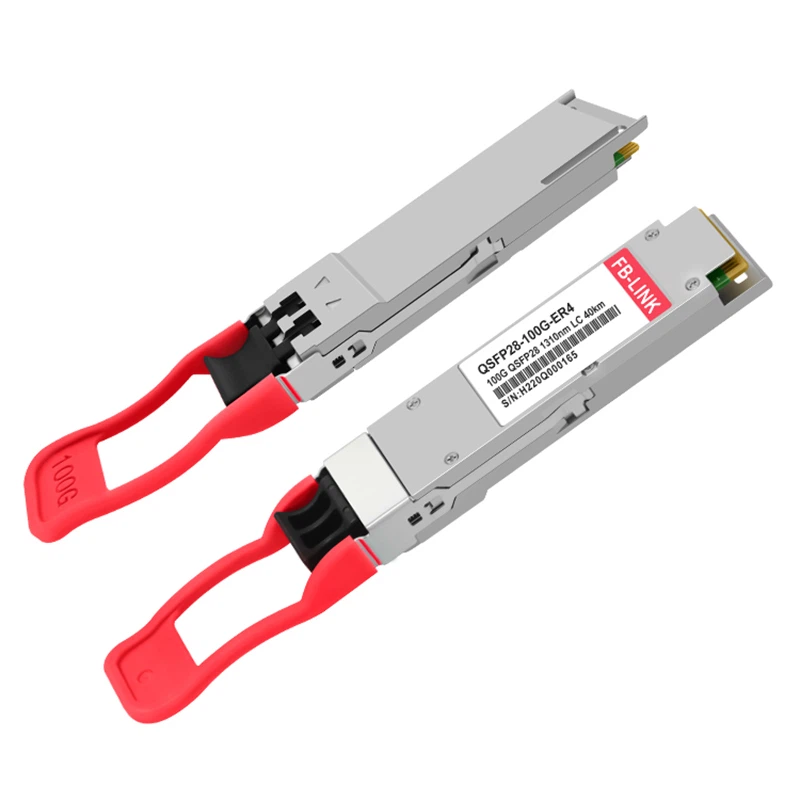
100G ER4 40km
This product is a 100Gb/s transceiver module designed for optical communication applications compliant to 100GBASE-ER4 Lite standard. The module converts 4 input channels of 25Gb/s electrical data to 4 channels of LAN WDM optical signals and then multiplexes them into a single channel for 100Gb/s optical transmission.

- Product Introduction
Description
|
Compatible |
100G ER4 |
Vendor Name |
FB-LINK |
|
Form Factor |
QSFP28 |
Max Data Rate |
103.125Gbps |
|
Wavelength |
1310nm |
Max Cable Distance |
40km |
|
Connector |
Duplex LC |
Media |
SMF |
|
Transmitter Type |
4xEML |
Receiver Type |
APD |
|
TX Power |
-2.9~4.5dBm |
Receiver Sensitivity |
<-20.9dBm |
|
Powerbudget |
18dB |
Receiver Overload |
-4.9dBm |
|
Power Consumption |
≤4.5W |
Extinction Ratio |
>4dB |
|
DDM/DOM |
Supported |
Commercial Temperature Range |
0 to 70°C (32 to 158°F) |
|
Packaging Technology |
BOX Packaging |
CDR(Clock Data Recovery) |
TX & RX Built-in CDR |
|
Protocols |
QSFP28 MSA Compliant |
Warranty |
3 Years |
Transceiver Block Diagram

Mechanical Dimensions

Fully compatible

Package

Network infrastructure demands continue to escalate as businesses push the boundaries of data transmission and cloud computing. Among the critical components enabling this digital transformation, optical transceivers stand out as essential building blocks for modern network architectures. The 100G ER4 QSFP28 module represents a sophisticated solution designed specifically for extended-reach applications where distance and reliability cannot be compromised.
What Makes Extended Reach Technology Essential
Data centers and enterprise networks increasingly require connectivity that spans greater distances without signal degradation. Traditional short-reach optical transceivers serve well within confined spaces, but metropolitan area networks, campus interconnects, and inter-data center links demand something more robust. The ER4 (Extended Reach 4-lane) technology addresses this challenge by utilizing advanced wavelength division multiplexing to maintain signal integrity across substantial distances.
The architecture leverages four parallel optical lanes, each operating at distinct wavelengths around the 1310nm spectrum. This approach allows the module to aggregate bandwidth while maintaining exceptional performance characteristics across fiber spans that would otherwise require costly signal regeneration equipment.
Key Applications Across Industries
Telecommunications providers deploy these optical transceivers extensively in metro networks where connecting central offices requires reliable 40-kilometer links. Financial institutions rely on this technology to ensure low-latency connections between trading floors and data centers, where milliseconds can translate to significant competitive advantages.
Cloud service providers use extended-reach modules to build resilient network topologies connecting availability zones within metropolitan regions. This geographical distribution enhances disaster recovery capabilities while maintaining the high-bandwidth connectivity essential for modern cloud architectures.
Research institutions and universities leverage this technology to interconnect campus facilities across significant distances, supporting bandwidth-intensive applications like high-performance computing clusters and collaborative research initiatives.
Technical Advantages Worth Considering
The QSFP28 form factor has become an industry standard due to its high port density and power efficiency. When combined with extended-reach capabilities, these optical transceivers deliver exceptional value by reducing the total cost of ownership. Organizations can eliminate intermediate optical amplification equipment, simplify network design, and reduce power consumption compared to alternative solutions.
Single-mode fiber compatibility ensures these modules work seamlessly with existing infrastructure investments. The duplex LC connector interface provides reliable physical connections that network engineers trust for mission-critical applications.
Built-in clock and data recovery functionality ensures signal integrity even as data traverses long fiber paths. Digital diagnostics and monitoring capabilities enable proactive maintenance, allowing IT teams to identify potential issues before they impact network performance.
Making the Right Choice for Your Network
Selecting appropriate optical transceivers requires careful consideration of multiple factors beyond simple distance requirements. Power budget calculations help determine if specific fiber plants can support extended-reach modules without additional amplification. Understanding extinction ratios and receiver sensitivity specifications ensures compatibility with existing network equipment.
Temperature requirements matter significantly for deployment planning. Standard commercial temperature ranges suit most controlled environments, while some installations may require modules rated for extended or industrial temperature specifications.
Compatibility verification remains crucial when sourcing network components. Quality manufacturers provide comprehensive compatibility matrices and testing reports that document interoperability with major switching platforms from vendors like Cisco, Juniper, Arista, and Dell.
Frequently Asked Questions
What's the difference between ER4 and other 100G optical transceivers?
ER4 modules are specifically engineered for extended distances up to 40 kilometers over single-mode fiber, while SR4 variants work over multimode fiber for much shorter distances (typically 70-100 meters), and LR4 modules bridge the gap with 10-kilometer reach. The choice depends entirely on your infrastructure requirements and existing fiber plant.
Can these modules work with switches from different manufacturers?
High-quality optical transceivers that follow MSA (Multi-Source Agreement) specifications are designed for broad compatibility. However, some network equipment may require specific coding or digital optical monitoring implementations. Always verify compatibility matrices or request testing confirmation from your supplier before large-scale deployments.
How do I monitor the health of deployed transceivers?
Modern modules include digital diagnostics monitoring that reports real-time parameters like transmit power, receive power, temperature, and voltage through standard management interfaces. Network management systems can poll this data to establish baseline performance and trigger alerts when values drift outside acceptable ranges.
What causes optical transceiver failures?
Common failure modes include contaminated fiber connections, physical damage to connectors, exceeding environmental specifications, power supply issues, and normal end-of-life degradation. Regular cleaning of fiber connectors, proper handling during installation, and monitoring of diagnostic parameters significantly extend operational life.
Are there power consumption differences between manufacturers?
While MSA specifications establish maximum power envelopes, implementation quality varies between manufacturers. Premium optical transceivers often feature optimized power management that reduces consumption below specification maximums, potentially lowering cooling requirements and operating costs in large deployments.
How long should I expect these modules to last?
Quality modules from reputable manufacturers typically include warranties of three years or more, though operational lifetimes often exceed warranty periods significantly when deployed within specifications. Proper environmental conditions, clean power delivery, and contamination-free fiber connections all contribute to extended service life.
What fiber type is required for 40-kilometer transmission?
Extended-reach applications mandate single-mode fiber with appropriate loss characteristics. The fiber plant should be evaluated for total insertion loss including splices, connectors, and patch panels. Clean, low-loss fiber infrastructure is essential for achieving full distance specifications.
Can I use these in DWDM systems?
Standard ER4 modules use LAN WDM wavelengths and are not designed for integration into dense wavelength division multiplexing systems. Organizations requiring DWDM functionality should specify appropriate tunable or colored optical transceivers designed specifically for that application.
Future-Proofing Your Infrastructure Investment
Network planning increasingly focuses on scalability and investment protection. While 400G and 800G technologies continue evolving, 100G connectivity remains the workhorse for countless applications where the balance of bandwidth, reach, and cost creates optimal value.
The modular nature of QSFP28 platforms allows for graceful technology transitions. As bandwidth demands grow, organizations can upgrade switch platforms while leveraging existing fiber infrastructure investments. This evolutionary approach minimizes disruption and spreads capital expenditures across multiple budget cycles.
Choosing reliable optical transceivers from manufacturers with proven track records ensures consistent performance and reduces the operational burden of managing network connectivity. Quality components, comprehensive testing, and responsive technical support transform connectivity infrastructure from a potential liability into a strategic advantage.
Network infrastructure decisions made today influence operational efficiency and business capabilities for years to come. Understanding the technical capabilities, application requirements, and implementation considerations surrounding extended-reach optical connectivity empowers IT leaders to make informed decisions that align technology investments with organizational objectives.
Hot Tags: 100g er4 40km, China 100g er4 40km suppliers, manufacturers, factory