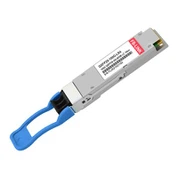
100G QSFP28 BiDi 80km Optical Transceiver for Single-Fiber Long-Haul Links
The 100G QSFP28 BiDi 80km transceiver is designed for high-capacity 100GbE and OTU4 point-to-point transmission over one strand of single-mode fiber. It is a practical choice when metro DCI, carrier backbone, enterprise WAN, or leased dark-fiber projects need 80km reach without consuming a duplex fiber pair.

- Product Introduction
100G QSFP28 BiDi 80km - Specification & Supply Snapshot
Quick-reference for procurement and network engineering. Confirm final values against the datasheet and your project requirements before order.
Technical quick-reference
| Field | Value |
|---|---|
| Form factor | QSFP28 (MSA), hot-pluggable |
| Application | 100GbE / OTU4, single-fiber point-to-point |
| Line coding | 4 × 25.78 Gb/s NRZ (≈103.125 Gb/s aggregate), CAUI-4 electrical |
| Max reach | Up to 80 km on OS2 single-mode fiber (single strand) |
| Optical link budget | ≈30 dB with host RS-FEC enabled [confirm per datasheet] |
| Required FEC | Host RS(528,514) at both ends - needed to reach rated 80 km |
| Wavelength plan | Side A: Tx ~1273–1287 nm / Rx ~1295–1309 nm (4λ each way); Side B reversed |
| Connector | Single LC (simplex), single-fiber BiDi [confirm LC/UPC] |
| Transmitter / Receiver | EML transmitter / high-sensitivity receiver (PIN or SOA per design) |
| Max power consumption | High-power QSFP28 class, ≤6.5 W [confirm exact figure] |
| Host port requirement | Must support high-power QSFP28 (≤6.5 W) port power class |
| DDM/DOM | Supported (SFF-8636 management): temp, Vcc, Tx/Rx power, laser bias |
Why Choose This 100G BiDi 80km Module
This module is built for teams that need to upgrade long-distance 100G links while protecting scarce fiber resources. Instead of using two fibers for transmit and receive, the BiDi design carries full-duplex traffic over one fiber strand by using complementary wavelength groups at both ends.
| Buying concern | How this module helps | Decision value |
| Limited dark fiber or high leased-fiber cost | Single-fiber BiDi transmission reduces fiber-pair consumption. | Better fiber utilization for metro, regional, and DCI expansion projects. |
| Long span link margin | 80km reach, high receiver sensitivity, EML transmitter, SOA/PIN receiver design. | More suitable for long-haul 100G links than short-reach LR4 or ER4 options. |
| Switch and router compatibility | QSFP28 MSA form factor with vendor-compatible EEPROM coding support. | Lower deployment risk across mixed switch, router, and transport platforms. |
| Before-bulk validation | Sample testing and port compatibility verification before mass purchase. | Helps procurement, engineering, and QA approve the same BOM faster. |
Best-Fit Applications for 100G BiDi 80km Deployment
The 100G BiDi 80km module for metro DCI is recommended when a network must carry 100G traffic across long fiber spans but available fiber count is constrained. It is especially useful for carriers, ISP aggregation, enterprise backbone expansion, and data center interconnect links where adding new fiber is expensive or slow.
- Metro data center interconnect: connects facilities across city or regional fiber routes using one single-mode fiber strand.
- Carrier and ISP backbone: supports point-to-point 100G transport over existing OS2 fiber infrastructure.
- Enterprise WAN and campus core: upgrades long-distance building or regional links without rebuilding the cable plant.
- 5G transport and aggregation: provides high-capacity optical handoff for transport nodes that require compact QSFP28 ports.
Key Specifications Buyers Should Confirm
| Item | Recommended confirmation before order |
| Module side pairing | Confirm Side A and Side B wavelength matching. Two modules with the same side will not establish a link. |
| Host port power class | Verify that the QSFP28 port can support the module power level required by long-reach BiDi optics. |
| FEC mode | Confirm host FEC settings during link bring-up, especially on 80km links where link margin matters. |
| Fiber plant loss | Check fiber attenuation, connector loss, splice loss, patch panel loss, and engineering margin before purchase. |
| Compatibility coding | For custom 100G QSFP28 BiDi 80km compatibility coding, provide switch/router model, firmware version, and required vendor code. |
100GBASE-BX80 QSFP28 Single Fiber Module Advantages
A 100GBASE-BX80 QSFP28 single fiber module is most valuable when the business case depends on saving fiber strands while keeping a compact QSFP28 interface. Compared with a duplex ZR4 module, the BiDi design simplifies single-strand utilization; compared with shorter BiDi options, the 80km version gives more room for metro and regional spans.
| Option | Typical reach | Fiber use | Best use case |
| 100G QSFP28 BiDi 20km | 20km | Single fiber | Short metro or access aggregation links. |
| 100G QSFP28 BiDi 40km | 40km | Single fiber | Medium metro spans and regional aggregation. |
| 100G QSFP28 BiDi 80km | 80km | Single fiber | Long metro DCI, carrier backbone, and scarce-fiber deployment. |
| 100G ZR4 80km duplex module | 80km | Duplex fiber | Long reach where a fiber pair is available and BiDi pairing is not required. |
Compatibility, Customization, and Sample Approval
Industrial buyers usually need more than a datasheet. They need the module to be recognized by the host platform, pass burn-in and traffic testing, and arrive with the correct label, part number, and matched A/B pairing. For OEM, integrator, and telecom procurement, we support project-based configuration before shipment.
Compatibility coding: Cisco, Arista, Juniper, Huawei, H3C, Dell, Mellanox/NVIDIA, and other switch/router ecosystems can be evaluated by project.
Matched A/B pair supply: modules can be marked and packed by side to reduce installation errors.
Private label support: label, PN, serial format, and packaging requirements can be discussed for distributors and OEM customers.
Pre-shipment testing: optical power, eye diagram, DDM, temperature, traffic, and compatibility checks can be arranged according to the order plan.
Quality and Testing Workflow for Long-Reach Links
For a 100G ZR4 BiDi QSFP28 sample testing project, the approval process should not stop at link-up. Engineering teams should validate wavelength side matching, host FEC mode, BER performance, DDM accuracy, module temperature, and total link budget under realistic fiber loss.
- Confirm host environment: share switch/router model, OS version, port type, and required compatibility code.
- Confirm fiber route: provide estimated distance, fiber type, connector count, splice count, and measured loss when available.
- Validate sample pair: test Side A and Side B together on the planned host platform.
- Approve batch order: lock BOM, coding, label, packaging, and QA report requirements.
- Deploy with records: label both ends clearly to avoid same-side pairing mistakes during installation.
Standards and Interoperability References
This product is positioned around QSFP28, CAUI-4 electrical interfaces, DDM/DOM management, and 100G Ethernet/OTU4 long-reach deployment requirements. For project documentation, buyers may also reference IEEE 802.3 Ethernet standards, the SNIA SFF-8636 management interface specification, and the SNIA SFF-8665 QSFP form-factor specification.
Optical Characteristics
The following optical characteristics are defined over the Recommended Operating Environment unless otherwise specified.
| Parameter | Symbol | Min. | Typical | Max | Unit | Notes | |
| Transmitter | |||||||
| Lane wavelength(range) | L0 | 1272.55 | 1273.55 | 1274.54 | nm | 2383x | |
| L1 | 1276.89 | 1277.89 | 1278.89 | nm | 2383x | ||
| L2 | 1281.25 | 1282.26 | 1283.27 | nm | 2383x | ||
| L3 | 1285.65 | 1286.66 | 1287.68 | nm | 2383x | ||
| L4 | 1294.53 | 1295.56 | 1296.59 | nm | 3283x | ||
| L5 | 1299.02 | 1300.05 | 1301.09 | nm | 3283x | ||
| L6 | 1303.54 | 1304.58 | 1305.63 | nm | 3283x | ||
| L7 | 1308.09 | 1309.14 | 1310.09 | nm | 3283x | ||
| Signaling rate, each lane | 25.78125 | 28.05 | Gb/s | ||||
| Side-mode suppression ratio | SMSR | 30 | |||||
| Total launch power | PT | 8.0 | 10.5 | dBm | |||
| Average launch power, each lane | Pavg | 2.0 | 4.5 | dBm | |||
| Extinction Ratio | ER | 6.0 | dB | ||||
| Difference in Launch Power between any Two Lanes (OMA) | Ptx,diff | 3.6 | dB | ||||
| Average launch power of OFF transmitter, each lane | Poff | -30 | dBm | ||||
| Transmitter reflectance | RT | -12 | dB | ||||
| RIN20OMA | RIN | -130 | dB/Hz | ||||
| Optical Return Loss Tolerance | TOL | 20 | dB | ||||
| Transmitter eye mask {X1, X2, X3, Y1, Y2, Y3} | {0.25, 0.4, 0.45, 0.25, 0.28, 0.4} | ||||||
| Receiver | |||||||
| Lane wavelength(range) | L0 | 1294.53 | 1295.56 | 1296.59 | nm | 2383x | |
| L1 | 1299.02 | 1300.05 | 1301.09 | nm | 2383x | ||
| L2 | 1303.54 | 1304.58 | 1305.63 | nm | 2383x | ||
| L3 | 1308.09 | 1309.14 | 1310.09 | nm | 2383x | ||
| L4 | 1272.55 | 1273.55 | 1274.54 | nm | 3283x | ||
| L5 | 1276.89 | 1277.89 | 1278.89 | nm | 3283x | ||
| L6 | 1281.25 | 1282.26 | 1283.27 | nm | 3283x | ||
| L7 | 1285.65 | 1286.66 | 1287.68 | nm | 3283x | ||
| Signaling rate, each lane | 25.78125 | 28.05 | Gb/s | ||||
| Average Receive Power, each Lane | -30 | -7 | dBm | ||||
| Receive Power (OMA), each Lane | -7 | dBm | |||||
| Receiver reflectance | -26 | dB | |||||
| Receiver sensitivity Average, each lane | SEN1 | -22 | dBm | 1 | |||
| SEN2 | -21 | dBm | 2 | ||||
| SEN3 | -28 | dBm | 3 | ||||
| SEN4 | -27 | dBm | 4 | ||||
| LOS Assert | LOSA | -40 | dBm | ||||
| LOS Deassert | LOSD | -29 | dBm | ||||
| LOS Hysteresis | LOSH | 0.5 | dB | ||||
Digital Diagnostic Functions
The following digital diagnostic characteristics are defined over the normal operating conditions unless otherwise specified.
| Parameter | Symbol | Min. | Max | Unit | Range |
| Temperature monitor absolute error | DMI_ Temp | -3 | 3 | oC | -40~85C |
| Supply voltage monitor absolute error | DMI _VCC | -3 | 3 | % | 0~Vcc |
| RX power monitor absolute error | DMI_RX | -3 | 3 | dB | -7~-30dBm |
| Bias current monitor error | DMI_ bias | -10 | 10 | % | 0~120mA |
| TX power monitor absolute error | DMI_TX | -3 | 3 | dB | 2~4.5dBm |
How to Select and Order This Module
For procurement teams comparing multiple 100G long-reach optics, the key decision is not only distance. The order should also specify fiber count, host platform, side pairing, FEC requirement, operating temperature, and whether the module must be coded as a specific vendor part number.
| Step | Information to provide | Why it matters |
| 1. Link requirement | 100GbE or OTU4, target distance, fiber type, measured loss. | Confirms whether 80km BiDi is the right optical budget choice. |
| 2. Host compatibility | Switch/router brand, model, firmware, port power limit. | Reduces the risk of EEPROM or power-class rejection. |
| 3. Pairing plan | Quantity of Side A and Side B modules, site labels, packaging rules. | Prevents same-side installation and simplifies field deployment. |
| 4. Commercial plan | Sample quantity, batch forecast, delivery destination, label requirements. | Supports quote, sample approval, and long-term supply planning. |
Request a Quote or Sample
Send your host platform, required coding, fiber span details, and target quantity. Our team can help confirm whether this 100G QSFP28 BiDi 80km module, a 100G QSFP28 80km duplex option, or another 100G QSFP28 transceiver is the safest choice for your project.
Related Technical Resources
- BiDi transceiver applications for single-fiber network design
- 100G QSFP28 selection guide for SR4, LR4, CWDM4, and PSM
- DDM digital diagnostic monitoring guide for optical modules
- Optical transceiver testing checklist before deployment
- Transceiver procurement guide for vendor selection
Frequently Asked Questions
Q: What is this 100G QSFP28 BiDi 80km module mainly used for?
A: It is mainly used for 100G point-to-point links over one strand of OS2 single-mode fiber, especially in metro DCI, carrier backbone, ISP aggregation, enterprise WAN, and other long-span networks where saving fiber resources matters.
Q: Does 100G QSFP28 BiDi 80km require matched pairs?
A: Yes. BiDi modules must be deployed as complementary A/B sides because each side transmits and receives on different wavelength groups. Two same-side modules will normally fail to link.
Q: Can this module replace a duplex 100G ZR4 module?
A: It can be considered when the target is 80km reach and only one fiber strand is available. If a duplex fiber pair is already available and the network standard requires a duplex ZR4 interface, a standard ZR4 module may be more appropriate.
Q: What should be checked before placing a bulk order?
A: Confirm host platform compatibility, port power limit, FEC configuration, optical link budget, fiber type, A/B side quantity, label requirements, and whether sample testing is needed before bulk shipment.
Q: Is DDM/DOM supported?
A: Yes. The module supports digital diagnostic monitoring for key operating parameters such as module temperature, supply voltage, transmit power, receive power, and laser bias current.
Q: Can the module be customized for OEM or project supply?
A: Yes. Custom coding, label, serial number format, packaging, and matched pair shipment can be discussed for OEM, distributor, system integrator, and telecom procurement projects.
Q: How do I request pricing?
A: Send the required quantity, target host brand/model, fiber distance, measured link loss if available, and required compatibility code through the contact form. For uncertain projects, sample validation is recommended before batch purchase.
Hot Tags: