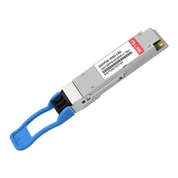
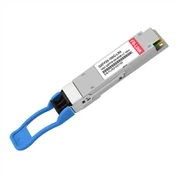
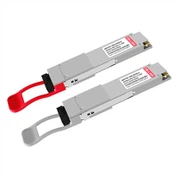
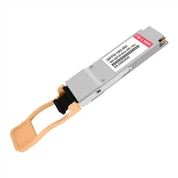
100G QSFP28 BIDI 40km
FB-LINK's single fiber Lambda QSFP28 BiDi ER transceiver module is designed for 100 Gigabit Ethernet links over 40 kilometers of SMF, compliant with IEEE802.3cd. This module has 4x25Gbps (NRZ) electrical interface signals and 1x100Gbps (PAM4) optical interface signals. The electrical interface complies with OIF CEI-28G-VSR and QSFP28 MSA; The optical side is compliant with 100G Lambda MSA 100G-ER1.

- Product Introduction
Product Features
● Simplex LC receptacle optical interface
● Single +3.3V power supply
● Up to 40km transmission on SMF
● EML laser and APD receiver
● Hot-pluggable QSFP28 MSA form factor
● Lane signaling rate 53.125GBd with PAM4
● Low power dissipation(Max:4.5W)
● Built in digital diagnostic function
● Operating case temperature range:0℃ to 70℃
● Compliant with IEEE 802.3bs and 100G Lambda MSA
● I2C Communication Interface
Applications
● 100GBASE-ER1-40 BIDI
● Transmission up to 40km
Functional Diagram

Electrical Characteristics (Top=0~70℃, Vcc=3.14~3.47V)
(Tested under recommended operating conditions,unless otherwise noted)
|
Parameter |
Symbol |
Min |
Typ |
Max |
Unit |
Notes |
||
|
Transmitter |
||||||||
|
Signaling rate |
Rate |
|
25.78 |
|
|
Gbps |
||
|
Differential data input swing |
Vin,pp |
100 |
|
900 |
mV |
|
||
|
Differential termination mismatch |
Tm |
|
|
10 |
% |
|
||
|
Receiver |
||||||||
|
Signaling rate |
Rate |
|
25.78 |
|
|
Gbps |
||
|
Differential data output swing |
Vout,pp |
100 |
|
900 |
mV |
|
||
|
Differential termination mismatch |
Tm |
|
|
10 |
% |
|
||
|
Transition time, 20% to 80% |
Tr,Tf |
9.5 |
|
|
ps |
|
||
|
Vertical Eye Closure |
VEC |
|
|
6.5 |
dB |
|
||
|
Eye width at 10-15robability |
EW15 |
0.57 |
|
|
UI |
|
||
|
Eye height at 10-15probability |
EH15 |
228 |
|
|
mV |
|
||
Optical Characteristics (Top=0~70℃, Vcc=3.14~3.47V)
(Tested under recommended operating conditions,unless otherwise noted)
|
Parameter |
Symbol |
Unit |
Min |
Typ |
Max |
Notes |
|||
|
Transmitter |
|||||||||
|
Signaling rate |
|
GBd |
53.125 |
|
|||||
|
Lane Wavelength Range |
λ1 |
nm |
1303.54 |
1304.58 |
1305.63 |
|
|||
|
λ2 |
nm |
1308.09 |
1309.14 |
1310.19 |
|
||||
|
Average launch power |
Pavg |
dBm |
1.7 |
|
7.1 |
1 |
|||
|
Outer Optical Modulation Amplitude (OMAouter) |
POMA1 |
dBm |
4.7 |
|
7.9 |
|
|||
|
Outer Optical Modulation Amplitude (OMAouter) (min)for 1.4 dB≤ TDECQ≤TDECQ (max) |
POMA2 |
dBm |
3.3+TEDCQ |
|
|
|
|||
|
Transmitter and Dispersion Eye Closure for PAM4 (TDECQ) (max) |
TDECQ |
dB |
|
|
3.9 |
|
|||
|
Extinction ratio |
ER |
dB |
5 |
|
|
|
|||
|
Side-mode suppression ratio |
SMSR |
dB |
30 |
|
|
|
|||
|
Average launch power of OFF transmittermax) |
POFF |
dBm |
|
|
–15 |
|
|||
|
Transmitter Reflectance |
RL |
|
|
|
-26 |
2 |
|||
|
Receiver |
|||||||||
|
Receive Rate |
|
GBd |
53.125 |
|
|||||
|
Lane Wavelength Range |
λ1 |
nm |
1308.09 |
1309.14 |
1310.19 |
|
|||
|
λ2 |
nm |
1303.54 |
1304.58 |
1305.63 |
|
||||
|
Overload Input Optical Power |
Pmax |
dBm |
-2.4 |
|
|
3 |
|||
|
Average Receive Power |
Pin |
dBm |
-16 |
|
-3.4 |
4 |
|||
|
Receiver sensitivity (OMAouter) (max For TECQ < 1.4 dB For 1.4 ≤ TECQ 3.6 dB For 1.4 ≤ TECOS 3.9 dB |
Psens1 |
dBm |
|
|
13.8
-15.2 + TECO |
5 |
|||
|
Return Loss |
RL |
dB |
-26 |
|
|
|
|||
|
Los De-Assert |
Pd |
dBm |
|
|
-16 |
|
|||
|
Los Assert |
Pa |
dBm |
-30 |
|
|
|
|||
Specifications
| Number | FBL-QSFP-100G-BX40 | Vendor Name | FB-LINK |
| Form Factor | QSFP28 | Max Data Rate | 106.25Gbps |
| Wavelength | 1309.14nm/1304.58nm | Max Cable Distance | 40km |
| Connector | Simplex LC | Media | SMF |
| Transmitter Type | MZM EML | Receiver Type | APD |
| Tx Power | 1.7~7.1dBm | Minimum Receiver Power | <-13.8dBm |
| Min Powerbudget | 15.5dBm | Receiver Overload | -3dBm |
| Power Consumption | ≤4.5W | Extinction Ratio | >5.0dB |
100G Connectivity for Data Center and Telecom


Understanding High-Speed Optical Transceivers: The Backbone of Modern Data Communication
The explosive growth of data centers, cloud computing, and 5G networks has created unprecedented demand for faster, more reliable connectivity solutions. Optical transceivers have emerged as the critical components enabling these high-bandwidth applications, transforming how data travels across networks worldwide.
What Makes Optical Transceivers Essential for Modern Networks?
Optical transceivers serve as the vital link between electrical and optical signals in fiber optic communication systems. These sophisticated devices convert electrical signals from network equipment into optical signals for transmission over fiber cables, and vice versa. As data demands continue to surge, the role of optical transceivers in maintaining network performance has become increasingly critical.
Modern optical transceivers leverage advanced modulation techniques like PAM4 (Pulse Amplitude Modulation 4-level) to achieve exceptional data rates exceeding 50 Gbps per lane. This technology enables network operators to maximize bandwidth efficiency while maintaining signal integrity over extended distances.
Key Advantages of Advanced Optical Transceivers
Superior Bandwidth Capacity
High-performance optical transceivers deliver multi-gigabit transmission speeds, supporting bandwidth-intensive applications such as video streaming, artificial intelligence workloads, and real-time analytics. The ability to transmit data at rates exceeding 25 Gbps per channel enables organizations to future-proof their infrastructure investments.
Extended Reach and Reliability
Optical transceivers utilizing optimized wavelength ranges around 1304-1310nm provide excellent chromatic dispersion characteristics, enabling reliable transmission over various fiber types. Advanced error correction and signal conditioning ensure consistent performance across diverse network topologies.
Power Efficiency
Operating within carefully controlled voltage ranges (typically 3.14-3.47V), modern optical transceivers balance high performance with energy efficiency. This characteristic becomes particularly valuable in large-scale deployments where power consumption directly impacts operational costs.
Compact Form Factors
Contemporary optical transceivers pack incredible functionality into standardized, hot-swappable modules. This design philosophy enables rapid deployment, simplified maintenance, and seamless network upgrades without system downtime.
Applications Driving Optical Transceiver Adoption
Data Center Interconnects
Optical transceivers form the foundation of modern data center architectures, connecting servers, storage arrays, and network switches. As data centers scale to accommodate cloud services and edge computing, the demand for high-density, high-speed optical transceivers continues to accelerate.
Telecommunications Infrastructure
Service providers rely on optical transceivers to deliver high-speed internet, mobile backhaul, and enterprise connectivity services. The ability to support multiple data rates and reach requirements makes optical transceivers indispensable for carrier networks.
Enterprise Networks
Organizations implementing high-performance computing clusters, storage area networks, and campus backbone infrastructure depend on optical transceivers to ensure low-latency, high-throughput connectivity between critical resources.
Technical Excellence in Optical Transceiver Design
Premium optical transceivers incorporate sophisticated engineering to achieve optimal performance across wide operating temperature ranges. Advanced thermal management ensures stable operation from 0°C to 70°C, making these devices suitable for diverse deployment environments.
The transmitter section of quality optical transceivers features precise laser control, maintaining tight wavelength tolerances and excellent side-mode suppression ratios above 30 dB. This precision minimizes optical interference and ensures clean signal transmission.
On the receiver side, optical transceivers employ sensitive detection circuits capable of recovering signals across a wide dynamic range. Advanced equalization and clock recovery circuits maintain signal integrity even in challenging conditions, with sensitivity levels reaching -16 dBm or better.
Selecting the Right Optical Transceivers for Your Network
Compatibility Considerations
When evaluating optical transceivers, verify compatibility with existing network equipment, including switches, routers, and media converters. Multi-source agreement (MSA) compliance ensures interoperability across vendor platforms.
Performance Requirements
Assess your bandwidth needs, transmission distances, and future growth projections. Optical transceivers are available in various speed grades and reach classifications to match specific application requirements.
Quality and Reliability Metrics
Look for optical transceivers with comprehensive testing certifications, including TDECQ (Transmitter and Dispersion Eye Closure Quaternary) measurements, extinction ratios, and bit error rate performance. These parameters directly impact long-term reliability and network uptime.
Environmental Factors
Consider the operating environment, including temperature extremes, humidity, and potential vibration or shock exposure. Industrial-grade optical transceivers offer enhanced durability for demanding applications.
The Future of Optical Transceiver Technology
The evolution of optical transceivers continues to accelerate, with emerging technologies promising even higher data rates and improved efficiency. Coherent detection, silicon photonics integration, and co-packaged optics represent the next frontier in optical transceiver innovation.
As artificial intelligence and machine learning workloads proliferate, the demand for ultra-low latency, high-bandwidth optical transceivers will only intensify. Organizations investing in quality optical transceiver solutions today position themselves for success in tomorrow's data-driven landscape.
Frequently Asked Questions About Optical Transceivers
Q: What is the difference between SFP and QSFP optical transceivers?
A: SFP (Small Form-factor Pluggable) optical transceivers typically support single-lane transmission up to 25 Gbps, while QSFP (Quad Small Form-factor Pluggable) modules aggregate four lanes to achieve 40 Gbps, 100 Gbps, or higher speeds. QSFP optical transceivers provide higher port density and bandwidth in the same physical space.
Q: How do I determine the maximum transmission distance for optical transceivers?
A: Transmission distance depends on several factors including fiber type (single-mode or multi-mode), operating wavelength, transmit power, and receiver sensitivity. Optical transceivers specify these parameters in their datasheets, with typical ranges from 100 meters for multi-mode to 40+ kilometers for long-reach single-mode applications.
Q: Can optical transceivers from different manufacturers work together?
A: Yes, provided both optical transceivers comply with the same industry standard specifications (such as IEEE or MSA agreements). However, always verify compatibility testing between specific vendor products, as subtle implementation differences can occasionally cause interoperability issues.
Q: What does TDECQ mean and why is it important?
A: TDECQ (Transmitter and Dispersion Eye Closure Quaternary) is a quality metric for PAM4 optical transceivers that measures signal integrity by accounting for transmitter imperfections and chromatic dispersion effects. Lower TDECQ values indicate better signal quality, with typical specifications requiring values below 3.9 dB for optimal performance.
Q: How often should optical transceivers be replaced or upgraded?
A: Optical transceivers typically offer service lives of 5-10 years when operated within specifications. However, consider upgrades when network bandwidth requirements exceed current capabilities, or when newer technology offers significant cost or performance advantages. Regular monitoring of optical power levels and bit error rates helps identify degrading modules before failures occur.
Q: What is the significance of wavelength range in optical transceivers?
A: Wavelength determines how the optical signal propagates through fiber, affecting attenuation and dispersion characteristics. Optical transceivers operating around 1310nm offer zero dispersion in standard single-mode fiber, making them ideal for high-speed applications. Different wavelength ranges also enable wavelength division multiplexing (WDM) for increased capacity.
Q: Do optical transceivers require special handling or installation procedures?
A: Yes, optical transceivers contain sensitive optical and electronic components. Always handle modules by the housing (never touch optical ports), use proper dust caps when not connected, and avoid static discharge during installation. Ensure fiber connectors are clean before insertion, and verify compatibility before hot-swapping modules in live systems.
Hot Tags: Optical Transceivers
You Might Also Like