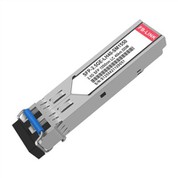
1.25G/2.5G XPON ONU STICK
1. With single fiber bidirectional data link GPON and EPON MAC functions
2.SC/UPC fiber optic interface, plug and play without configuration
3.Transmitter 1310nm burst mode, receiver 1490nm APD TIA continuous mode
4.Digital diagnostic function (DDM) compatible with SFF-8472
5.Compatible with SFP MSA
6.Low electromagnetic interference and excellent electrostatic discharge protection

- Product Introduction
| Parameter | Symbol | Min. | Typ. | Max. | Unit | Notes |
| Power supply Voltage |
VCC
|
3.13 | 3.3 | 3.47 | V | |
| Power Dissipation | PD | 2.10 | 2.5 | w |
Max value under High
temp environment
|
|
|
Operating Case Temperature
|
Tc
Tc
|
0
-40
|
+70
+85
|
°C
°C
|
||
|
Operating Humidity Range
|
OH
|
5
|
95
|
%
|
||
|
Data Rate
|
TX:1.244 / RX:2.488
TX:1.25 / RX:1.25
|
Gbit/s
|
GPON MODE
EPON MODE
|
|||
|
Data Rate Drift
|
-100
|
+100
|
PPM
|
|||
|
Optical Center Wavelength
|
λC
|
1290
|
1310 | 1330 | nm | |
|
Spectral Width (-20dB)
|
∆λ
|
1
|
nm | |||
|
Side Mode Suppression Ratio
|
SMSR
|
30
|
dB
|
|||
|
Average Launch Optical Power
|
AOP
|
0.5
|
4 | dBm |
Launched into SMF Fiber
|
|
|
Burst off Average Output Power
|
-45
|
dBm | ||||
|
Extinction Ratio
|
ER
|
10
|
dB
|
|||
|
Rise/Fall Time (20%-80%)
|
TR/TF
|
|
0.26 |
ns
|
Unfiltered PRBS 223 - 1@1244.16 Mbps
|
|
|
RIN15OMA
|
-115
|
dB/Hz
|
||||
|
Optical Return Loss Tolerance
|
-15
|
dB
|
||||
|
Transmitter Reflectance
|
-10
|
dB | ||||
|
Transmitter and Dispersion Penalty
|
TDP
|
1 | dB |
Transmit on 20km SMF.
|
||
|
Data Output Differential Swing
|
300 | 1200 | mV |
CML output, AC coupled
|
||
|
Loss of Signal - Low
|
0 | 0.4 | V | |||
|
Loss of Signal - High
|
2.4 |
Vcc
|
V |

High-speed data transmission has become the lifeblood of modern telecommunications, and optical transceivers stand at the heart of this revolution. These compact yet powerful devices bridge the gap between electrical signals in network equipment and optical signals traveling through fiber optic cables, enabling the blazing-fast internet speeds and reliable connections we depend on every day.
What Makes Optical Transceivers Essential?
Optical transceivers serve as bidirectional communication modules, simultaneously transmitting and receiving data across fiber optic networks. Unlike traditional copper-based solutions, these devices leverage light wavelengths to carry information over vast distances with minimal signal degradation. This capability makes them indispensable for telecommunications providers, internet service providers, and enterprise networks seeking to deliver consistent, high-performance connectivity.
The technology operates on a elegantly simple principle: electrical signals from network switches or routers are converted into optical signals for transmission, while incoming optical signals are converted back into electrical form. This seamless translation happens at incredible speeds, often measured in gigabits per second, without introducing noticeable latency.
Applications Across Multiple Network Architectures
Modern optical transceivers support various network standards, with GPON (Gigabit Passive Optical Network) and EPON (Ethernet Passive Optical Network) being among the most prevalent in fiber-to-the-home deployments. These standards define how data flows between central offices and end-user premises, with optical transceivers serving as the critical interface points.
Service providers rely on these modules to deliver fiber internet services to residential and business customers. The compact form factor allows multiple transceivers to be deployed in dense configurations, maximizing port density in central offices and distribution points. This scalability proves essential as bandwidth demands continue their upward trajectory.
Key Performance Characteristics
When evaluating optical transceivers for network deployments, several performance factors deserve careful consideration. Transmission distance capabilities determine how far signals can travel before requiring amplification or regeneration. Most fiber access network transceivers support ranges from 10 to 20 kilometers on standard single-mode fiber, though specialized versions can extend much further.
Wavelength selection represents another crucial specification. Different wavelengths allow multiple signals to coexist on the same fiber strand without interference, a technique called wavelength division multiplexing. This approach dramatically increases fiber capacity without requiring additional cable installation.
Power efficiency has grown increasingly important as network operators seek to reduce operational costs and environmental impact. Modern optical transceivers incorporate sophisticated power management features, drawing minimal electricity while maintaining consistent performance across varying temperature conditions.
Installation and Integration Considerations
Deploying optical transceivers requires attention to several practical factors. Physical compatibility with host equipment is paramount-transceivers must match the form factor and electrical interface of the network device they're installed into. Common form factors include SFP, SFP+, and XFP, each with distinct dimensions and capabilities.
Fiber optic connector types must align with existing infrastructure. SC, LC, and FC connectors represent the most common options, each offering specific advantages in terms of density, ease of connection, and mechanical stability. Proper connector selection ensures reliable physical layer performance and simplifies maintenance procedures.
Operating temperature ranges merit consideration for outdoor or environmentally challenging deployments. Industrial-grade optical transceivers withstand wider temperature swings than standard commercial versions, maintaining stability in cabinet or pole-mounted installations exposed to weather extremes.
Quality and Reliability Standards
Network equipment faces demanding reliability requirements, as service interruptions translate directly into customer dissatisfaction and revenue loss. Premium optical transceivers undergo rigorous testing protocols covering thermal cycling, vibration resistance, and long-term operational stability. These qualification procedures help ensure devices maintain specified performance throughout their operational lifetime.
Bit error rate testing validates that transmitted data arrives intact and uncorrupted. Even microscopic error rates can prove unacceptable in high-capacity networks, where millions of transactions occur every second. Quality optical transceivers achieve error rates far below industry thresholds, providing confidence in data integrity.
Future-Proofing Network Infrastructure
As bandwidth requirements continue their relentless growth, optical transceivers evolve to meet emerging needs. Next-generation devices support higher data rates, improved power efficiency, and enhanced diagnostic capabilities. Many modern optical transceivers incorporate digital diagnostic monitoring, providing real-time visibility into temperature, optical power levels, and other operating parameters.
This diagnostic capability transforms network management, enabling proactive identification of degrading connections before they impact service quality. Operators can monitor transceiver health remotely, scheduling maintenance during optimal windows and reducing emergency call-outs.
Frequently Asked Questions
What is the typical lifespan of optical transceivers?
Quality optical transceivers typically provide 10-15 years of reliable service when operated within specified parameters. However, actual lifespan depends on factors including operating temperature, power cycling frequency, and environmental conditions. Monitoring diagnostic parameters helps identify devices approaching end-of-life before they fail.
Can optical transceivers from different manufacturers be mixed in the same network?
Yes, optical transceivers following industry standards should interoperate regardless of manufacturer. However, some network equipment vendors implement proprietary features or coding that may require using their specific modules. Always verify compatibility with your equipment vendor before deployment.
How do I choose between GPON and EPON optical transceivers?
The choice depends on your network architecture and regional standards. GPON offers slightly higher efficiency and more sophisticated quality-of-service features, making it popular in North America and parts of Asia. EPON provides simpler implementation and easier integration with existing Ethernet infrastructure, seeing widespread adoption in Asia. Both deliver excellent performance for fiber access networks.
What causes optical transceivers to fail?
Common failure modes include laser degradation, overheating due to inadequate ventilation, physical damage to fiber connections, and electrical overstress. Proper installation with adequate cooling, clean fiber connections, and surge protection dramatically reduces failure rates.
Do optical transceivers require special handling or storage?
Yes, optical transceivers contain sensitive components requiring careful handling. Store units in anti-static packaging in temperature-controlled environments. Avoid touching optical ports, and always use protective caps when not connected. Clean fiber end-faces before making connections to prevent contamination-related signal degradation.
How much bandwidth can a single optical transceiver support?
Current optical transceivers support data rates from 1 Gbps to 400 Gbps depending on the device type and application. Fiber access network transceivers typically operate at 1.25 to 10 Gbps, while data center and long-haul transceivers achieve much higher speeds. Always match transceiver specifications to your bandwidth requirements and growth projections.
What maintenance do optical transceivers require?
Optical transceivers are largely maintenance-free once properly installed. However, periodic inspection of fiber connections for cleanliness and secure seating helps maintain optimal performance. Monitoring diagnostic parameters through network management systems provides early warning of potential issues. If performance degrades, cleaning fiber end-faces often resolves problems without requiring transceiver replacement.
Hot Tags: Optical Transceivers
You Might Also Like