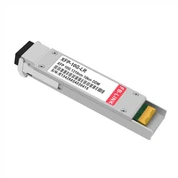
400G OTU Single Channel Transponder Card
400G OTU Single Channel Transponder Card 400G OTU Single Channel Transponder Card Multi-Rate Client Side 4xQSFP28 Line Side 400G CFP2 DCO DWDM 01 400G CONHERENT DWDM CFP2 TO QSFP28 CARD 4*100G ↔ 400G electrical layer multiplexing/demultiplexing, converting into 400G rate WDM standard...

- Product Introduction

Monitor your network through B/S architecture network management

400G OTN Muxponder Product Specification

Specifications
| Function | Description |
| Interface |
Client side interface: 4 ports, hot-pluggable based on QSFP28 Line side interface: 1 port, hot-pluggable based on CFP2 DCO |
| Line side multiplexing structure |
200G: OCh <-> OTUC2 <-> ODUC2 <-> ODU4 400G: OCh <-> OTUC4 <-> ODUC4 <-> ODU4 |
| Client side signal Mapping mode | 100GE <-> ODU4 |
| Support service type |
100Gbps OTU4 |
| FEC technology |
200G: SD-FEC 400G: SD-FEC |
| Occupied slot number | Support FBL-OTDCI series chassis occupy 2slots |
| Network management |
Support performance monitoring and alarm monitoring Support port loopback, port shutdown and ALS functions |
Understanding High-Performance Optical Transceivers for Modern Data Center Infrastructure
The rapid expansion of cloud computing, 5G networks, and data-intensive applications has created unprecedented demand for bandwidth. Network operators and data center managers are increasingly turning to advanced optical transceivers to meet these challenges while maintaining cost efficiency and operational flexibility.
What Makes Modern Optical Transceivers Essential
Optical transceivers serve as the critical bridge between electrical and optical signals in network infrastructure. These sophisticated devices enable high-speed data transmission across fiber optic cables, supporting everything from metro networks to long-haul telecommunications. As bandwidth requirements continue to escalate, the evolution of optical transceivers has become central to network modernization strategies.
Traditional copper-based connections cannot sustain the throughput needed for contemporary applications. Optical transceivers overcome distance limitations and electromagnetic interference while delivering superior performance at 100Gbps, 200Gbps, 400Gbps, and beyond. This technology forms the backbone of hyperscale data centers and carrier networks worldwide.
Key Technologies Behind Next-Generation Solutions
Modern optical transceivers incorporate several advanced technologies to achieve their impressive capabilities. Coherent detection methods, which use CFP2 DCO (Coherent Pluggable Optical Module) form factors, enable longer transmission distances and higher spectral efficiency. These modules support wavelength division multiplexing, allowing multiple data streams to travel simultaneously over a single fiber strand.
The integration of Soft-Decision Forward Error Correction represents another crucial advancement. This error correction mechanism significantly improves signal quality by identifying and correcting transmission errors in real-time, ensuring data integrity even over extended distances. SD-FEC technology has become standard in high-capacity optical transceivers, enabling reliable 200G and 400G transmission.
Hot-pluggable interfaces based on QSFP28 standards provide operational flexibility that network administrators value. The ability to replace or upgrade optical transceivers without shutting down entire systems minimizes downtime and simplifies maintenance procedures. This modularity supports diverse client-side connectivity requirements while future-proofing infrastructure investments.
Architecture and Signal Processing
The multiplexing structure within advanced optical transceivers demonstrates remarkable engineering sophistication. These devices map client signals through multiple transformation layers, converting Ethernet frames into optical channel signals suitable for long-distance transmission. The mapping process ensures compatibility across different network segments while optimizing spectral efficiency.
For 100 Gigabit Ethernet services, optical transceivers perform seamless conversion to OTU4 framing, which adds overhead for management and error correction. This transformation happens transparently, allowing network equipment to communicate regardless of underlying transport mechanisms. The ability to support various service types makes optical transceivers versatile solutions for mixed network environments.
Line-side interfaces aggregate multiple client signals into higher-capacity optical channels. This aggregation reduces the number of wavelengths required, lowering operational costs and simplifying network design. The scalability from 100G client interfaces to 200G or 400G line rates demonstrates how optical transceivers adapt to growing bandwidth demands.
Network Management and Monitoring Capabilities
Effective network operation requires comprehensive visibility into equipment performance. Modern optical transceivers provide extensive telemetry, including real-time monitoring of optical power levels, bit error rates, temperature readings, and transceiver status. This data enables proactive maintenance strategies that prevent outages before they impact services.
Performance monitoring features built into optical transceivers track key metrics over time, helping network engineers identify degradation trends. Alarm systems trigger notifications when parameters exceed predefined thresholds, allowing rapid response to potential issues. These management capabilities integrate with broader network orchestration platforms through standard protocols.
Port-level controls offer additional operational flexibility. Administrators can configure loopback modes for troubleshooting, implement automatic laser shutdown for safety compliance, or selectively disable interfaces for maintenance. Such granular control over optical transceivers enhances both reliability and safety in production environments.
Deployment Considerations
Physical space constraints in data centers make form factor selection critical. Optical transceivers that occupy two slots in standard chassis deliver higher performance while maintaining reasonable density. This balance between capability and footprint suits applications where throughput takes priority over absolute port count.
The choice between different interface types depends on specific use cases. Client-side connections typically require multiple lower-speed ports to aggregate traffic from various sources. Line-side interfaces prioritize long-distance, high-capacity transmission. Understanding these distinct roles helps optimize optical transceivers deployment for particular network architectures.
Power consumption and cooling requirements also influence deployment decisions. Higher-performance optical transceivers generate more heat, necessitating adequate thermal management. Planning for power delivery and airflow ensures reliable operation and maximizes equipment lifespan.
Industry Applications and Use Cases
Telecommunications carriers rely on optical transceivers to expand network capacity without deploying additional fiber infrastructure. By increasing the data rate per wavelength, providers can meet subscriber demand while deferring expensive outside plant construction. This approach proves particularly valuable in urban areas where fiber routes are saturated.
Enterprise data centers use optical transceivers to interconnect facilities and support disaster recovery architectures. High-bandwidth links between primary and secondary sites enable real-time data replication, ensuring business continuity. The reliability of optical connections surpasses alternatives for mission-critical applications.
Content delivery networks depend on optical transceivers to distribute media files efficiently across geographically dispersed edge locations. Low-latency, high-throughput connections ensure smooth streaming experiences for end users. As video quality increases from HD to 4K and 8K, the bandwidth provided by advanced optical transceivers becomes increasingly essential.
Future Trends in Optical Networking
The trajectory toward 800G and 1.6T optical transceivers is already underway. As switch silicon evolves to support higher speeds, optical interfaces must keep pace. Next-generation coherent technology will enable these rates while maintaining backward compatibility with existing infrastructure.
Artificial intelligence and machine learning integration represents an emerging frontier. Intelligent optical transceivers could autonomously optimize transmission parameters based on real-time conditions, maximizing performance without manual intervention. Predictive analytics might identify component failures before they occur, revolutionizing maintenance practices.
Disaggregated network architectures are changing how operators deploy optical transceivers. Open standards and white-box hardware enable mixing components from different vendors, increasing competition and driving innovation. This trend promises greater flexibility and potentially lower costs for network operators.
Frequently Asked Questions
What is the difference between client-side and line-side interfaces in optical transceivers?
Client-side interfaces connect to local network equipment like switches and routers, typically using multiple lower-speed ports to aggregate various data sources. Line-side interfaces handle long-distance optical transmission over fiber networks, often at higher aggregate speeds. This separation allows optical transceivers to efficiently convert between access and transport network requirements.
How does Forward Error Correction improve optical transceiver performance?
FEC adds redundant data to transmissions, enabling receivers to detect and correct errors without retransmission. Soft-Decision FEC examines signal quality probabilistically rather than making binary decisions, recovering from more severe impairments. This technology extends transmission distances and improves reliability, making it essential for high-capacity optical transceivers.
Why are hot-pluggable optical transceivers important for network operations?
Hot-pluggable designs allow technicians to install, remove, or replace optical transceivers without powering down network equipment. This capability minimizes service disruptions during maintenance, upgrades, or repairs. The flexibility to change optical transceivers on-demand also helps operators adapt quickly to changing network requirements.
What factors determine the maximum distance optical transceivers can transmit?
Several variables affect transmission distance, including optical power budget, fiber quality, wavelength, dispersion characteristics, and error correction capabilities. Higher-performance optical transceivers with coherent detection and advanced FEC typically support longer reaches. Environmental factors and the number of intermediate components also play roles in determining practical distance limits.
How do optical transceivers support different service types and protocols?
Modern optical transceivers perform protocol-agnostic transport, mapping various client signals (Ethernet, OTU, etc.) into standardized optical formats. This flexibility allows the same hardware to support multiple service types simultaneously. Signal processing within optical transceivers handles protocol conversion transparently, ensuring interoperability across diverse network equipment.
What maintenance practices extend optical transceiver lifespan?
Regular monitoring of performance metrics helps identify degradation before failures occur. Keeping connectors clean prevents signal loss and damage to optical interfaces. Ensuring adequate cooling and operating within specified temperature ranges prevents premature component aging. Implementing automated laser shutdown features protects personnel and equipment during maintenance activities.
How do optical transceivers integrate with network management systems?
Standards-based interfaces expose telemetry data and control functions to management platforms. SNMP, NETCONF, and proprietary APIs enable monitoring, configuration, and alarm retrieval. This integration allows optical transceivers to participate in automated provisioning workflows and centralized fault management systems, streamlining operations across large networks.
Hot Tags: Optical Transceivers
You Might Also Like