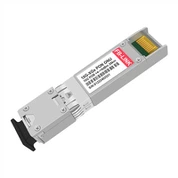
QSFP28 100G BIDI 20KM
100 GBASE QSFP28 BIDI 20KM Transceiver LC Single Fiber QSFP28 100G BIDI 20KM is a cutting-edge technology that promises to revolutionize the way we communicate, transmit data and stay connected. This advanced technology has the potential to provide us with faster, more reliable, and more...

- Product Introduction
| products |
 |
 |
 |
| Model number | FBL-QSFP28-LR1 | FBL-QSFP28-LR2 | FBL-QSFP28-ER1 |
| Description | 100G BIDI LR1 | 100G BIDI LR2 | 100G BIDI ER1 |
| Data Rate | 100Gb/s | 100Gb/s | 100Gb/s |
| Reach | 10KM | 20KM | 30KM |
| Tx | 1271nm/1331nm EML | 1271nm/1331nm EML | 1304.58nm/1309.14nm EML |
| Rx | PIN | PIN | APD |
| Output Power | -1.4~+4.5dBm | 0~+4.5dBm | 0~+5.6dBm |
| sensitivity | ≦-6.1dBm | ≦-9dBm | ≦-12.5dBm |
The exponential growth of data traffic has pushed network infrastructure to its limits, making high-speed optical transceivers an essential component of contemporary telecommunications systems. These sophisticated devices serve as the critical bridge between electrical and optical signals, enabling seamless data transmission across fiber optic networks at unprecedented speeds.
The Evolution of 100G Bidirectional Technology
Optical transceivers have undergone remarkable transformation in recent years, with 100G bidirectional (BIDI) solutions emerging as game-changers for bandwidth-intensive applications. Unlike traditional transceivers that require separate fibers for transmission and reception, BIDI optical transceivers utilize wavelength division multiplexing (WDM) technology to achieve duplex communication over a single fiber strand. This innovation dramatically reduces fiber infrastructure costs while maintaining exceptional performance standards.
The engineering behind modern optical transceivers incorporates advanced laser technologies, including Electro-absorption Modulated Lasers (EML) for transmission and highly sensitive photodetectors for reception. These components work in harmony to ensure reliable signal integrity across various distance requirements, from metropolitan area networks to long-haul deployments.
Key Considerations When Selecting Optical Transceivers
When evaluating optical transceivers for network deployment, several critical factors demand attention. Distance requirements fundamentally shape transceiver selection, as different applications necessitate varying reach capabilities. Short-reach solutions excel in data center interconnects, while extended-reach optical transceivers prove indispensable for campus networks and telecommunications backbones.
Power budget analysis remains equally crucial. The relationship between output power and receiver sensitivity determines the maximum achievable distance with adequate signal quality. High-performance optical transceivers balance these parameters to deliver optimal link margins, ensuring network reliability even under challenging conditions.
Wavelength compatibility represents another essential consideration. Modern optical transceivers leverage specific wavelength pairs to maximize spectral efficiency and minimize chromatic dispersion effects. This careful wavelength selection enables stable operation across diverse fiber types and environmental conditions.
Application Scenarios for Advanced Optical Transceivers
Data center operators increasingly rely on optical transceivers to support cloud computing infrastructure, where microsecond-level latency and massive bandwidth capacity are non-negotiable. These transceivers facilitate high-speed server-to-server communication, storage area network connections, and data center interconnectivity.
Telecommunications service providers deploy optical transceivers throughout their access, metro, and core networks. The versatility of these devices allows carriers to standardize equipment while accommodating varying distance and capacity requirements through appropriate transceiver selection.
Enterprise networks benefit significantly from optical transceivers in campus connectivity scenarios. Whether connecting buildings across a corporate campus or linking remote offices, these devices provide the bandwidth scalability necessary for modern business applications including video conferencing, cloud services, and distributed computing.
Technical Advantages of Contemporary Optical Transceivers
Energy efficiency stands as a paramount advantage of modern optical transceivers. Advanced power management techniques minimize heat generation and reduce operational costs, contributing to more sustainable network operations. This efficiency becomes particularly valuable in large-scale deployments where cumulative power savings translate to substantial economic benefits.
Form factor standardization has simplified network planning and maintenance. Hot-swappable optical transceivers enable seamless equipment upgrades without network downtime, while industry-standard interfaces ensure broad compatibility across vendor ecosystems. This interoperability reduces vendor lock-in and provides procurement flexibility.
Signal quality maintenance over extended distances represents perhaps the most impressive capability of premium optical transceivers. Through sophisticated equalization algorithms and advanced modulation schemes, these devices preserve signal integrity even when operating near their maximum specified reach.
Future Trends in Optical Transceiver Technology
The trajectory of optical transceivers points toward even higher data rates and increased integration. Silicon photonics promises to revolutionize transceiver manufacturing by enabling mass production of integrated optical components at semiconductor-like scale and cost structures. This evolution will make high-performance optical transceivers accessible to broader market segments.
Coherent detection technology, traditionally reserved for long-haul applications, is migrating into shorter-reach optical transceivers. This advancement unlocks superior spectral efficiency and enhanced transmission distance, future-proofing network investments against escalating bandwidth demands.
Frequently Asked Questions
What are optical transceivers and why are they important? Optical transceivers are electro-optical devices that convert electrical signals into optical signals for transmission over fiber optic cables, and vice versa for reception. They are critical components in modern networks because they enable high-speed data transmission over long distances with minimal signal loss, making them essential for data centers, telecommunications networks, and enterprise connectivity.
How do bidirectional optical transceivers differ from traditional transceivers? Bidirectional optical transceivers transmit and receive data over a single fiber strand using different wavelengths for each direction, while traditional transceivers require two separate fibers. This technology reduces fiber infrastructure costs by up to 50% and simplifies cable management, making BIDI optical transceivers ideal for fiber-constrained environments.
What factors determine the maximum transmission distance of optical transceivers? The maximum reach of optical transceivers depends on several factors: output power, receiver sensitivity, fiber quality, wavelength selection, and chromatic dispersion. The power budget (difference between transmitter output and receiver sensitivity) must account for fiber attenuation, connector losses, and safety margins to ensure reliable operation.
Can optical transceivers from different manufacturers work together? Yes, when they comply with Multi-Source Agreement (MSA) standards such as QSFP28. These standards ensure physical compatibility, electrical interfaces, and optical specifications align across vendors. However, it's essential to verify wavelength compatibility, especially for BIDI optical transceivers where transmit and receive wavelengths must match correctly.
What is the difference between PIN and APD receivers in optical transceivers? PIN photodiodes offer good sensitivity for shorter distances and lower cost, while Avalanche Photodiodes (APD) provide higher sensitivity through internal gain mechanisms, enabling longer transmission distances. APD-based optical transceivers are typically used for extended-reach applications where maximum receiver sensitivity is critical.
How do environmental factors affect optical transceiver performance? Operating temperature, humidity, and electromagnetic interference can impact optical transceiver performance. Quality transceivers include temperature compensation circuits and robust housing to maintain specifications across commercial (0-70°C) or industrial (-40-85°C) temperature ranges. Proper installation in controlled environments ensures optimal longevity and reliability.
What maintenance do optical transceivers require? Optical transceivers are generally maintenance-free, but regular inspection of fiber connections is recommended. Keep optical interfaces clean using approved cleaning tools, monitor performance parameters through digital diagnostics, and ensure proper ventilation around transceivers to prevent thermal issues. Replace transceivers showing degraded optical power or increased error rates.
Hot Tags: Optical Transceivers
You Might Also Like