





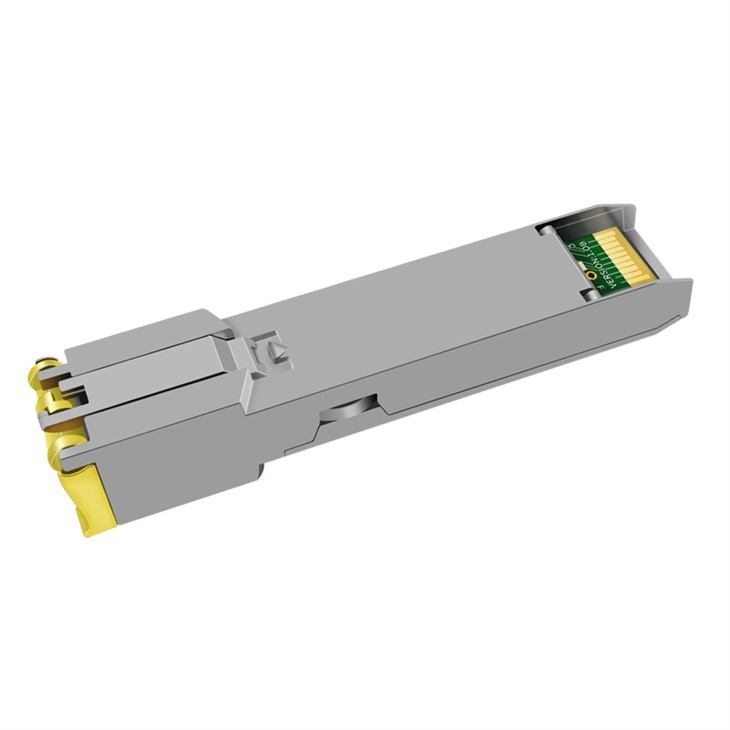


Sfp Rj45 10gb
sfp rj45 10gb electrical port module: It is a hot-swappable module, uses SFP+ packaging, RJ45 connector, transmission rate is 10G, transmission distance can reach 30m, its port supports shielded twisted pair, and can support non- Shielded twisted pair.

- Product Introduction
Product Features
● Available in hot-swappable SFP+ package
● Compliant with SFF-8431/8432 SFP+ MSA and IEEE 802.3an sfp rj45 10gb 10 Gigabit Ethernet standards
● Compatible with IEEE 802.3az, IEEE 802.3bz 5GBASE-T and 2.5GBASE-T standards
● Supports TX disable and RX_Los functions
● Use Category 5e (Cat5e) or better network cable to support 100/1000BASE-T
● Adaptive with other 10GBase-T PHY
● XFI/5GBASE-R/2500BASE-X/SGMII, SGMII adaptive
● MDI/MDIX Crossover
● Maximum transfer rate up to 10Gbps
● The transmission distance through Category 6/Cat6a (Cat6/Cat6a) network cable can be up to 30m
● Maximum power consumption is less than 2.5W
● RJ-45 interface
● Access physical layer IC via 2-wire serial bus
● Full metal housing (low EMI)
● Supports multiple loopback modes for testing and troubleshooting
● Built-in cable monitoring and link diagnostics
● Supports unshielded and shielded twisted pairs
● Operating temperature range from 0 to 70 degrees Celsius
● Power supply voltage 3.3V
● Comply with RoHS environmental standards (lead-free)
Products Description
| Model | sfp rj45 10gb | Vendor Name | FB-LINK |
| Form Factor | SFP+ | Data Rate | 10Gbps |
| Power Consumption | ≤2.5W | Cable Distance | 30m@Cat6a/Cat7 or Better |
| Connector | RJ-45 | Cable Type | Copper |
| EMC | Supported | MTBF | 5000000 Hours |
| Industrial Temperature Range | -40 to 85℃ | Protocols | IEEE 802.3an, IEEE 802.3az, SFP+ MSA, SFF-8431 |
Network connectivity has evolved dramatically over the past decade, with businesses demanding faster, more reliable data transmission solutions. At the heart of this transformation lie optical transceivers, sophisticated devices that enable seamless communication across diverse network architectures. These compact modules have become indispensable components for organizations seeking to maximize bandwidth while maintaining cost efficiency.
What Makes Optical Transceivers Essential for Network Performance
Optical transceivers serve as the critical interface between networking equipment and transmission media. These intelligent devices convert electrical signals into optical signals and vice versa, facilitating high-speed data transfer across various distances. Modern enterprises rely on these modules to support everything from data center operations to telecommunications infrastructure.
The versatility of optical transceivers extends beyond traditional fiber optic applications. Copper-based transceiver solutions have emerged as powerful alternatives, particularly for short-distance connections where fiber deployment may be impractical or cost-prohibitive. These copper variants deliver exceptional performance for inter-rack connections, top-of-rack switching, and server aggregation scenarios.
Key Advantages of Next-Generation Transceiver Technology
When evaluating optical transceivers for network deployment, several factors distinguish superior solutions from basic offerings. High-speed capabilities at 10 gigabits per second have become the standard for enterprise environments, ensuring adequate bandwidth for data-intensive applications and future growth requirements.
Energy efficiency represents another crucial consideration. Advanced optical transceivers incorporate intelligent power management features, significantly reducing operational costs while supporting environmental sustainability initiatives. Low power consumption doesn't compromise performance – modern modules deliver robust connectivity while maintaining minimal energy footprints.
Temperature resilience separates industrial-grade optical transceivers from consumer-level alternatives. Harsh environment deployments require modules that maintain consistent performance across extreme temperature ranges, ensuring network reliability regardless of ambient conditions. This durability proves essential for outdoor installations, industrial facilities, and challenging operational environments.
Selecting the Right Transceiver Solution for Your Infrastructure
Understanding your specific network requirements forms the foundation of effective optical transceiver selection. Distance requirements directly influence module choice – copper-based solutions excel in short-reach applications up to 30 meters, while fiber variants support extended distances measured in kilometers.
Protocol compatibility ensures seamless integration with existing network equipment. Leading optical transceivers adhere to industry standards, guaranteeing interoperability across multi-vendor environments. This standardization eliminates compatibility concerns and simplifies network management.
Form factor compatibility matters equally. SFP+ modules offer compact dimensions ideal for high-density deployments, allowing maximum port utilization in space-constrained environments. This density optimization proves particularly valuable in data center applications where rack space commands premium value.
Implementation Best Practices for Optimal Performance
Successful optical transceiver deployment requires attention to several critical factors. Proper cable selection ensures modules operate at rated specifications – for copper transceivers, Cat6a or Cat7 cabling provides the necessary performance characteristics for 10Gbps transmission.
Environmental considerations influence long-term reliability. While standard optical transceivers function adequately in controlled environments, industrial applications demand modules rated for extended temperature ranges. These ruggedized solutions maintain operational integrity from negative 40 to 85 degrees Celsius, supporting deployment flexibility across diverse scenarios.
Regular monitoring and maintenance extend transceiver lifespan and prevent unexpected failures. Quality modules feature impressive mean time between failures (MTBF) ratings exceeding 500,000 hours, translating to decades of reliable operation under normal conditions.
Frequently Asked Questions About Optical Transceivers
What is the difference between fiber and copper optical transceivers?
Fiber optical transceivers use light signals transmitted through glass or plastic fibers, supporting longer distances up to 100 kilometers. Copper transceivers utilize electrical signals over twisted-pair cabling, optimized for short-reach applications typically under 100 meters. Both types serve distinct purposes within network architectures.
Can I mix different brands of optical transceivers in the same network?
Yes, when optical transceivers comply with industry standards like IEEE 802.3 and MSA specifications, they maintain interoperability across different manufacturers. However, verifying compatibility with your specific switch or router model before deployment is recommended.
How do I know if my network switch supports 10Gbps optical transceivers?
Check your switch specifications for SFP+ port availability. These ports, distinct from standard SFP ports, support 10 gigabit speeds. Most modern enterprise switches include SFP+ capabilities, but legacy equipment may require upgrades.
What does energy-efficient Ethernet (EEE) mean for optical transceivers?
Energy-efficient Ethernet, defined by IEEE 802.3az, allows optical transceivers to enter low-power states during periods of reduced traffic. This feature can reduce power consumption by up to 50% without impacting network availability or performance.
Do optical transceivers require special handling or installation procedures?
While optical transceivers are robust devices, handle them carefully to avoid physical damage. Always use the extraction tool when removing modules, never force insertion, and keep dust caps on unused ports. For fiber variants, inspect and clean connectors before installation.
How long can I expect optical transceivers to last in my network?
Quality optical transceivers typically feature MTBF ratings between 500,000 to 1,000,000 hours. Under normal operating conditions, this translates to 10-20 years of reliable service. Industrial-grade modules in harsh environments may experience shorter lifespans but still deliver exceptional durability.
Are copper-based optical transceivers suitable for data center environments?
Absolutely. Copper optical transceivers excel in data center applications for short-distance connections between racks, typically within the same row. They offer cost advantages over fiber for these distances while delivering identical 10Gbps performance.
Future-Proofing Your Network Infrastructure
The evolution of optical transceivers continues accelerating, with emerging technologies promising even greater capabilities. Understanding current standards and anticipated developments helps organizations make informed investment decisions that protect long-term network viability.
Selecting quality optical transceivers from reputable manufacturers ensures access to ongoing support, firmware updates, and compatibility with future networking equipment. This forward-thinking approach maximizes return on investment while maintaining the flexibility to adapt as business requirements evolve.
Network infrastructure represents a critical business asset. By leveraging advanced optical transceiver technology, organizations build robust, scalable connectivity solutions capable of supporting today's demands while accommodating tomorrow's innovations.
Hot Tags: Optical Transceivers
You Might Also Like


