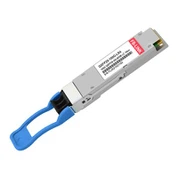
QSFP28 SR4
QSFP28 SR4 is a parallel 100Gb/s Quad Small Form-factor Pluggable (QSFP28 SR4) optical module. It provides increased port density and total system cost savings.

- Product Introduction
Products Description
● Up to 100m OM4 MMF transmission
● Operating case temperature: 0 to 70℃
● Single 3.3V power supply
● Maximum power consumption 2W
● MTP/MPO optical connector
Products Specification
| Compatible | QSFP28 SR4 | Vendor Name | FB-LINK |
| Form Factor | QSFP28 | Max Data Rate | 103.125Gbps |
| Wavelength | 850nm | Max Cable Distance | 70m@OM3/100m@OM4 |
| Connector | MTP/MPO-12 | Media | MMF |
| Transmitter Type | VCSEL 850nm | Receiver Type | PIN |
| TX Power | -8.4~2.4dBm | Receiver Sensitivity | <-10.3dBm |
| Powerbudget | 1.9dB | Receiver Overload | 2.4dBm |
| Power Consumption | ≤1.8W | Extinction Ratio | >3dB |
| DDM/DOM | Supported | Commercial Temperature Range | 0 to 70°C (32 to 158°F) |
| CDR (Clock and Data Recovery) | TX & RX Built-in CDR | FEC Function | Supported |
| Protocols | IEEE 802.3bm, QSFP28 MSA, SFF-8665, SFF-8636, RoHS, CPRI, eCPRI | Warranty | 3 Years |
Transceiver Block Diagram
The 100GBASE QSFP28 SR4 has a center wavelength of 850nm and can provide four independent sending and receiving channels, each with a running speed of up to 25G. The transmission distance when used with OM3 multimode fiber is 70m, and when used with OM4 multimode fiber, the transmission distance is 100m.
Optical Interface Lanes and Assignment
Figure 3 shows the orientation of the multi-mode fiber facets of the optical connector. Table 1 provides the lane assignment.

Compatible brands
FB-LINK's 100G QSFP28 SR4 optical transceiver has successfully tested through the following switch list:
| Cisco | Alcatel Lucent | Netgear |
| Mellanox | Allied Telesis | SMC |
| Juniper | Solare Flare | Foundry |
| Huawei | Winyao | Force 10 |
| Arista | ZTE | Linksys |
| Dell | D-Link | McAfee |
| Broadcom | TP-Link | Extreme |
| Qlogic(Cavium) | Ruijie | Marconi |
| Cheisio | Maipu | Blade |
| Intel | Feixun | Hirschmann |
Company strength

OEM&ODM customization, after-sales service, and strict guarantee of delivery time
FB-LINK provides customized product labeling and packaging services, and both end module compatibility brands can be customized. Regular sources of goods are shipped 24 hours a day, with a 3-year warranty and a 15 day free return and exchange. Our dedicated customer service is available online for 7 * 24 hours.

Production Capacity
Standardized and automated production equipment ensures stable product performance. Complete range of products, capable of mass production, one-stop procurement to save you time

Quality and testing are checked layer by layer
High quality imported core components, each product undergoes 13 strict testing processes such as incoming material detection signal, compatibility testing, aging, and outbound, ensuring quality assurance.


Related products

QSFP56 200G SR4

QSFP28 100G SR4

SFP28 25G SR

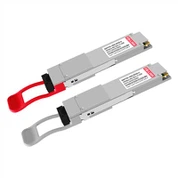
200G QSFP56 to 2*100G QSFP28 SR4
Understanding QSFP28 SR4 Optical Transceivers: Your Complete Guide to High-Speed Data Center Connectivity
When network infrastructure demands exceptional performance and reliability, optical transceivers become the critical components that keep data flowing seamlessly. The QSFP28 SR4 represents a breakthrough in short-reach multimode connectivity, delivering 100G speeds that modern data centers require.
What Makes QSFP28 SR4 Optical Transceivers Essential for Modern Networks
High-performance optical transceivers have revolutionized how enterprises handle bandwidth-intensive applications. The QSFP28 SR4 variant specifically addresses the growing need for cost-effective, high-density solutions in data center environments where fiber runs remain under 100 meters.
These compact modules leverage VCSEL (Vertical-Cavity Surface-Emitting Laser) technology operating at 850nm wavelength, providing an optimal balance between performance and power efficiency. The four-channel parallel optics architecture splits 100Gbps throughput across multiple fibers, ensuring robust transmission even in demanding conditions.
Key Performance Advantages of Advanced Optical Transceivers
Extended Reach Capabilities
Modern optical transceivers designed for multimode fiber environments excel at various distances. With OM3 fiber, these modules reliably transmit up to 70 meters, while OM4 fiber extends that capability to 100 meters. This flexibility allows network architects to design infrastructure without constant concern about distance limitations.
Thermal Management Excellence
Operating across a wide temperature range from 0°C to 70°C, these optical transceivers maintain stability in diverse environmental conditions. Whether deployed in temperature-controlled server rooms or edge computing locations with variable climates, consistent performance remains guaranteed.
Power Efficiency That Scales
Drawing less than 2 watts during maximum operation, energy-conscious data centers benefit from reduced cooling requirements and lower operational costs. When multiplied across hundreds or thousands of ports, these efficiency gains translate into substantial savings.
Technical Innovation in Optical Transceivers Design
The integration of both transmit and receive Clock and Data Recovery (CDR) circuits ensures signal integrity over the entire transmission path. This built-in intelligence automatically compensates for dispersion and timing variations that could otherwise degrade performance.
Forward Error Correction (FEC) support further enhances reliability by detecting and correcting transmission errors in real-time. For mission-critical applications where packet loss is unacceptable, this feature provides essential protection.
Digital Diagnostics Monitoring (DDM) capabilities embedded within these optical transceivers enable proactive network management. Real-time visibility into temperature, voltage, optical power, and other parameters helps prevent failures before they impact operations.
Applications Where Optical Transceivers Deliver Maximum Value
Data Center Interconnects
High-density spine-leaf architectures rely heavily on optical transceivers to create scalable networks. The QSFP28 form factor's compact size allows for maximum port density while maintaining thermal efficiency.
5G Infrastructure
Telecom providers deploying 5G networks utilize these optical transceivers for fronthaul and midhaul connections. Support for CPRI and eCPRI protocols ensures compatibility with Radio Access Network equipment.
Cloud Computing Environments
Hyperscale cloud providers demand optical transceivers that combine performance with reliability. The three-year warranty coverage reflects the robust design engineered for continuous operation.
Selecting the Right Optical Transceivers for Your Network
Compatibility verification stands as the first consideration. While MSA (Multi-Source Agreement) compliance ensures broad interoperability, testing with specific switch hardware confirms seamless integration.
Fiber infrastructure assessment determines optimal module selection. Organizations with existing OM3 cabling can achieve 70-meter reaches, while those investing in OM4 fiber unlock the full 100-meter capability of these optical transceivers.
Future bandwidth planning also influences procurement decisions. Although designed for 100G today, QSFP28 optical transceivers provide a migration path as network demands evolve.
Frequently Asked Questions About Optical Transceivers
What's the difference between OM3 and OM4 fiber with these optical transceivers?
OM3 and OM4 are both multimode fiber types, but OM4 offers superior modal bandwidth. With these optical transceivers, OM3 supports distances up to 70 meters while OM4 extends reach to 100 meters at 100Gbps speeds. OM4 is the preferred choice for new installations requiring maximum flexibility.
Can these optical transceivers work in existing 40G infrastructure?
While the QSFP28 form factor physically resembles QSFP+ modules used for 40G, these optical transceivers are specifically designed for 100G operation. They require switches with 100G-capable ports. However, some switches support backward compatibility modes - consult your hardware specifications.
How does the MTP/MPO connector configuration work?
The MTP/MPO-12 connector uses 12 fibers in total, with 8 active fibers (4 for transmit, 4 for receive) and 4 unused positions. This parallel optics approach allows each 25Gbps lane to operate independently, creating the aggregate 100Gbps throughput. Standard polarity methods ensure proper transmit-receive alignment.
What maintenance do optical transceivers require?
These optical transceivers are largely maintenance-free, but monitoring through DDM functions is recommended. Regular inspection of fiber connectors for contamination, ensuring adequate cooling airflow, and firmware updates when available help maximize lifespan. The three-year warranty covers manufacturing defects.
Why is CDR important in optical transceivers?
Clock and Data Recovery circuits regenerate degraded signals, compensating for jitter and dispersion accumulated during transmission. Without CDR, optical transceivers would have significantly reduced reach and higher bit error rates, especially at 100Gbps speeds where timing margins are tight.
Are these optical transceivers suitable for outdoor deployments?
The commercial temperature range of 0°C to 70°C suits many environments, but outdoor installations with extreme temperatures may require industrial-grade optical transceivers. Additionally, weatherproof enclosures are necessary to protect connectors and maintain the operating temperature range.
How does FEC improve optical transceiver performance?
Forward Error Correction adds redundant data that allows the receiver to detect and correct transmission errors without retransmission. This improves effective link budget and enables these optical transceivers to operate closer to their sensitivity limits while maintaining low error rates essential for data integrity.
What protocols do these optical transceivers support?
Full compliance with IEEE 802.3bm ensures 100GBASE-SR4 Ethernet compatibility. The MSA compliance guarantees interoperability across vendors. Additionally, support for CPRI and eCPRI protocols makes these optical transceivers suitable for wireless infrastructure applications beyond traditional data networking.
Hot Tags: Optical Transceivers
You Might Also Like