





25G DWDM 10KM
25G DWDM 10KM is a transceiver designed for Ethernet links with data rates up to 25.78 Gb/s and link lengths up to 10 km.

- Product Introduction
Products Detail
Hot-swappable SFP+ package
100GHz ITU, C-band DWDM-cooled EML laser and PIN photodiode,
Transmission distances up to 10 kilometers
SFP+ MSA and SFF-8472 compliant with duplex LC socket
RoHS compliant
Single +3.3V supply
Power consumption <1W
Real-time digital diagnostic monitoring
Operating enclosure temperature: Standard: 0 to +70°C
Products Description
| Form Factor | SFP28 | Wavelength | C17-C61 |
| Connector | Duplex LC | Distance | 10km |
| Cable Type | SMF | DDM | Yes |
| TX Power | -2~6dBm | Receiver Sensitivity | <-12dBm |

DWDM Wavelength Table
| Channel | Frequency(THz) | Wavelength(nm) | Channel | Frequency(THz) | Wavelength(nm) |
| C21 | 192.1 | 1560.606 | C41 | 194.1 | 1544.526 |
| C22 | 192.2 | 1559.794 | C42 | 194.2 | 1543.73 |
| C23 | 192.3 | 1558.983 | C43 | 194.3 | 1542.936 |
| C24 | 192.4 | 1558.173 | C44 | 194.4 | 1542.142 |
| C25 | 192.5 | 1557.363 | C45 | 194.5 | 1541.349 |
| C26 | 192.6 | 1556.555 | C46 | 194.6 | 1540.557 |
| C27 | 192.7 | 1555.747 | C47 | 194.7 | 1539.766 |
| C28 | 192.8 | 1554.94 | C48 | 194.8 | 1538.976 |
| C29 | 192.9 | 1554.134 | C49 | 194.9 | 1538.186 |
| C30 | 193 | 1553.329 | C50 | 195 | 1537.397 |
| C31 | 193.1 | 1552.524 | C51 | 195.1 | 1536.609 |
| C32 | 193.2 | 1551.721 | C52 | 195.2 | 1535.822 |
| C33 | 193.3 | 1550.918 | C53 | 195.3 | 1535.036 |
| C34 | 193.4 | 1550.116 | C54 | 195.4 | 1534.25 |
| C35 | 193.5 | 1549.315 | C55 | 195.5 | 1533.465 |
| C36 | 193.6 | 1548.515 | C56 | 195.6 | 1532.681 |
| C37 | 193.7 | 1547.715 | C57 | 195.7 | 1531.898 |
| C38 | 193.8 | 1546.917 | C58 | 195.8 | 1531.116 |
| C39 | 193.9 | 1546.119 | C59 | 195.9 | 1530.334 |
| C40 | 194 | 1545.322 | C60 | 196 | 1529.553 |
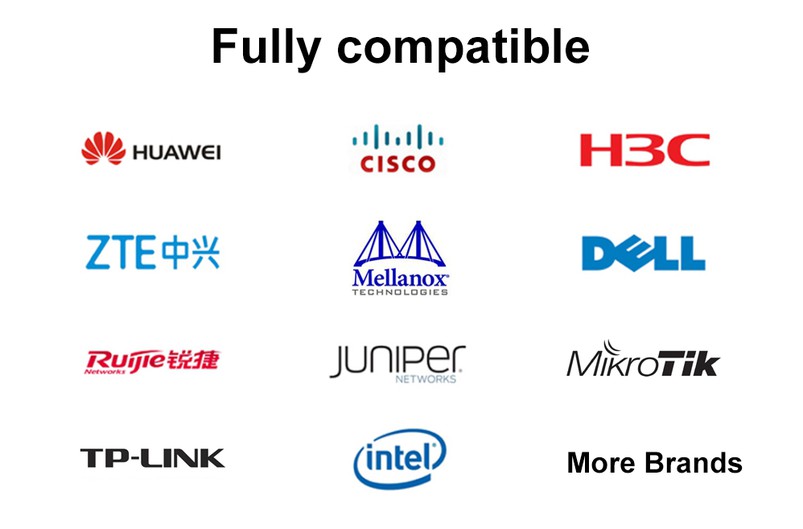
Compatible
High-Performance SFP28 Optical Transceivers: The Future of Data Center Connectivity
Network infrastructure demands continue to escalate, and optical transceivers have emerged as the backbone of modern high-speed data transmission. When selecting the right connectivity solution for your network, understanding the capabilities and specifications of advanced optical transceivers becomes essential for ensuring optimal performance and reliability.
Understanding SFP28 Optical Transceivers
Optical transceivers have revolutionized how data centers and enterprise networks handle bandwidth-intensive applications. The SFP28 form factor represents a significant leap forward, delivering 25Gbps performance in a compact, hot-swappable package that seamlessly integrates with existing network infrastructure.
These advanced optical transceivers utilize CWDM (Coarse Wavelength Division Multiplexing) technology across the C17-C61 wavelength spectrum, enabling multiple channels to operate simultaneously over single-mode fiber. This wavelength flexibility makes them ideal for metropolitan area networks and long-distance applications where efficient spectrum utilization is critical.
Key Advantages of Modern Optical Transceivers
The latest generation of optical transceivers delivers exceptional performance across multiple parameters. With duplex LC connectivity, these modules provide reliable bidirectional communication that ensures consistent data flow. The single-mode fiber compatibility extends transmission distances up to 10 kilometers, making these optical transceivers perfect for campus networks, inter-building connections, and metro applications.
Digital Diagnostic Monitoring (DDM) capability sets these optical transceivers apart from legacy solutions. Real-time monitoring of temperature, voltage, laser bias current, transmit power, and receive power enables proactive network management and reduces downtime through predictive maintenance strategies.
Performance Specifications That Matter
When evaluating optical transceivers, transmit power and receiver sensitivity are critical metrics. Premium optical transceivers deliver transmit power ranging from -2 to 6 dBm, ensuring strong signal output across varying network conditions. The receiver sensitivity threshold of better than -12 dBm guarantees reliable signal detection even in challenging environments with higher attenuation.
These specifications work together to create a robust link budget, providing the margin necessary for stable operation across the full 10-kilometer range. Network administrators can deploy these optical transceivers with confidence, knowing they'll maintain signal integrity throughout their operational lifetime.
Applications and Use Cases
Optical transceivers with these specifications excel in diverse networking scenarios. Data centers leverage them for rack-to-rack connectivity and inter-switch links, while telecommunications providers deploy them for metro ethernet services. Enterprise networks utilize these optical transceivers for building-to-building connections, and service providers rely on them for CWDM network architectures.
The hot-swappable nature of SFP28 optical transceivers enables seamless upgrades and maintenance without network downtime. This flexibility ensures that your infrastructure can evolve alongside growing bandwidth demands while maintaining backwards compatibility with existing installations.
Frequently Asked Questions
What makes SFP28 optical transceivers different from SFP+ modules?
SFP28 optical transceivers support 25Gbps data rates compared to the 10Gbps limitation of SFP+ modules. While maintaining the same compact form factor, SFP28 technology delivers 2.5 times higher bandwidth, making it essential for modern high-density network environments. These optical transceivers are also designed for next-generation applications requiring greater throughput.
How does DDM functionality benefit network operations?
Digital Diagnostic Monitoring in optical transceivers provides real-time visibility into module performance parameters. Network administrators can monitor temperature, optical power levels, and other critical metrics without specialized equipment. This capability enables predictive maintenance, faster troubleshooting, and improved network reliability by identifying potential issues before they cause failures.
Can these optical transceivers work with existing single-mode fiber infrastructure?
Absolutely. These optical transceivers are specifically designed for single-mode fiber compatibility, allowing seamless integration with existing SMF deployments. The 10-kilometer reach ensures they work effectively with standard metro and campus fiber installations without requiring infrastructure upgrades.
What is the significance of CWDM wavelength support?
CWDM wavelength support (C17-C61) allows multiple optical transceivers to operate over the same fiber pair using different wavelengths. This multiplexing capability dramatically increases fiber utilization efficiency, reducing the need for additional fiber strands and lowering infrastructure costs while scaling network capacity.
How do I ensure compatibility with my existing switches?
Modern SFP28 optical transceivers follow industry-standard MSA (Multi-Source Agreement) specifications, ensuring broad compatibility across major switch vendors. Always verify that your switch supports SFP28 interfaces and 25Gbps operation. The hot-swappable design means you can test compatibility without network disruption.
What maintenance do optical transceivers require?
Optical transceivers require minimal maintenance when properly deployed. Keep duplex LC connectors clean using approved fiber cleaning tools, monitor DDM parameters regularly for performance trends, and ensure adequate cooling within network equipment. Avoid frequent insertion and removal cycles, and protect unused modules in dust-free storage.
Maximizing Your Investment in Optical Transceivers
Selecting the right optical transceivers requires balancing performance requirements, distance needs, and budget considerations. The combination of SFP28 form factor, CWDM wavelength flexibility, and robust diagnostic capabilities creates a future-proof solution that grows with your network.
Quality optical transceivers represent a strategic investment in network reliability and performance. By choosing modules with comprehensive DDM support and strong optical specifications, organizations build infrastructure that delivers consistent results while simplifying operational management through enhanced visibility and control.
Whether upgrading existing infrastructure or designing new network segments, modern optical transceivers provide the foundation for high-performance connectivity. Their proven reliability, extensive feature set, and standards-based design ensure they'll continue serving critical network functions for years to come.
Hot Tags: 25g dwdm 10km, China 25g dwdm 10km suppliers, manufacturers, factory
You Might Also Like


