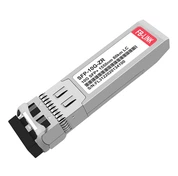
25G CWDM 10KM
The 25G CWDM 10KM transceiver uses LC duplex connector, cwdm wavelength, providing up to 10km transmission distance over single mode fiber (SMF).25G CWDM optical modules feature low threshold, high bandwidth, and high output optical power.

- Product Introduction
Products Description
25G CWDM 10KM

Products Description
● Hot-pluggable SFP28 form factor
● Supports 9.83/10.13/10.31/24.33/25.78Gb/s bit rate
● Power dissipation <1W
● Industrial case temperature range of -40°C to 85°C
● Single 3.3V power supply
● Maximum link length of 10km on Single Mode Fiber (SMF)
● Class 1 FDA Laser Safety and RoHS Compliant
● 25G DFB transmitter and 25G PIN receiver
● CWDM for Multiple Applications over One Duplex Fiber
● Digital Optical Monitoring Capability for Strong Diagnostic Capabilities
● RoHS compliant
Products Description
| Product type | SFP28 | Distance | 10KM |
| Rate | 25Gb/s | TX Power | 0~6dBm |
| Connector | Duplex Lc | Receiver Sensitivity | <-14dBm |
| Wavelength | 1270-1610nm | Temperature Range | 0~70℃ |
Compatible

Application scenario

Next-Generation DWDM SFP28 Transceiver: Revolutionizing High-Speed Optical Networks
The evolution of data center infrastructure demands sophisticated optical solutions that can handle unprecedented bandwidth requirements. DWDM (Dense Wavelength Division Multiplexing) technology has emerged as the cornerstone of modern fiber optic communications, enabling multiple data channels to transmit simultaneously over a single fiber strand. This advanced optical transceiver represents a breakthrough in DWDM implementation, delivering enterprise-grade performance for metropolitan area networks and data center interconnects.
Understanding DWDM Technology in Modern SFP28 Applications
DWDM systems maximize fiber capacity by multiplexing multiple wavelengths across the extended spectrum range, fundamentally transforming how organizations approach network scalability. This particular optical module leverages DWDM principles to achieve exceptional transmission performance across medium-distance deployments, making it ideal for campus networks, metropolitan rings, and inter-building connectivity.
The integration of DWDM capability within the compact SFP28 form factor represents a significant engineering achievement. Organizations can now deploy wavelength-specific channels without the infrastructure overhead traditionally associated with DWDM deployments, enabling rapid network expansion while maintaining precise wavelength allocation across the extended band spectrum.
Superior Performance Characteristics
This optical transceiver delivers consistent twenty-five gigabit per second throughput across distances reaching ten kilometers, providing the perfect balance between speed and reach for mid-range applications. The optimized power budget ensures reliable signal integrity even in challenging environmental conditions, while the wide operating temperature tolerance supports deployment in diverse facility environments from climate-controlled data centers to industrial edge locations.
The duplex LC connector interface ensures compatibility with existing fiber infrastructure, eliminating costly connector conversions. Enhanced receiver sensitivity guarantees robust signal detection even with moderate optical path loss, reducing the need for inline amplification in most deployment scenarios.
Strategic Advantages of DWDM Implementation
Deploying DWDM-enabled transceivers delivers immediate operational benefits. Network architects can construct multi-wavelength systems without dense fiber bundles, dramatically reducing conduit requirements and installation costs. Each wavelength operates independently, allowing gradual capacity expansion as bandwidth demands grow without disrupting existing services.
The wavelength flexibility across the extended DWDM spectrum enables precise channel planning, ensuring optimal separation to minimize crosstalk and maximize system performance. This granular control over wavelength assignment allows network operators to design resilient architectures with built-in redundancy and failover capabilities.
Ideal Deployment Scenarios
Data Center Interconnection: Organizations operating multiple data center facilities benefit from DWDM technology by establishing high-capacity links without exhausting fiber resources. Each wavelength carries dedicated traffic types, simplifying network segmentation and quality of service implementation.
Metropolitan Area Networks: Service providers leverage DWDM transceivers to deliver multi-tenant services across urban fiber rings, with each customer assigned dedicated wavelengths for guaranteed performance and security isolation.
Enterprise Campus Networks: Large corporate campuses utilize DWDM solutions to interconnect buildings with substantial bandwidth while maintaining infrastructure simplicity. The extended wavelength range supports multiple independent networks over shared fiber paths.
5G Fronthaul and Backhaul: Mobile network operators deploy DWDM-capable modules to aggregate cell site traffic efficiently, supporting the massive bandwidth requirements of next-generation wireless infrastructure.
Technical Excellence in Optical Design
The optical engine incorporates advanced modulation techniques optimized for DWDM applications, ensuring clean spectral output that minimizes adjacent channel interference. Precision wavelength control maintains ITU grid compliance across the entire operating temperature range, essential for multi-vendor DWDM system compatibility.
Stringent transmit power specifications guarantee consistent output levels, simplifying optical link budget calculations and ensuring predictable system behavior. The enhanced receiver design provides substantial margin against optical penalties introduced by chromatic dispersion and polarization mode dispersion over the supported distance.
Future-Proof Network Architecture
Investing in DWDM infrastructure positions organizations for long-term success. As bandwidth requirements inevitably increase, DWDM systems scale elegantly by adding wavelengths rather than fibers. This growth path protects capital investments while providing clear upgrade trajectories aligned with business expansion.
The combination of high-speed operation and wavelength diversity creates resilient networks capable of supporting mission-critical applications. Redundant wavelength paths enable sub-second failover, maintaining service continuity even during fiber cuts or equipment failures.
Frequently Asked Questions
What makes DWDM technology superior to traditional optical solutions?
DWDM multiplies fiber capacity by enabling multiple independent channels over a single fiber pair. Instead of deploying additional fiber cables as bandwidth needs grow, organizations simply add wavelengths to existing infrastructure. This approach dramatically reduces installation costs, simplifies cable management, and accelerates deployment timelines while providing dedicated channels with guaranteed performance characteristics.
Can this transceiver integrate with existing network infrastructure?
Absolutely. The standard duplex LC connector ensures compatibility with prevalent fiber infrastructure, while the SFP28 form factor fits universally into modern switching and routing platforms. The DWDM wavelength specification follows ITU standards, guaranteeing interoperability with multiplexing equipment from various manufacturers. Organizations can implement DWDM capabilities without replacing existing fiber plants or network hardware.
What distance limitations should I consider for deployment planning?
This module excels in metropolitan and campus applications where transmission distances range up to ten kilometers. The optical power budget accommodates typical insertion losses from connectors, splices, and passive DWDM multiplexers within this range. For longer distances, consider optical amplification or alternative transceiver options designed for extended reach applications.
How does operating temperature affect DWDM performance?
The commercial temperature range from zero to seventy degrees Celsius covers standard data center, office, and many industrial environments. The wavelength stability across this temperature spectrum ensures consistent DWDM grid compliance, maintaining signal quality and preventing channel drift that could cause interference. Precision thermal compensation maintains optimal performance regardless of ambient conditions.
What bandwidth scalability does DWDM provide?
Each DWDM wavelength delivers independent twenty-five gigabit capacity. In a fully populated DWDM system utilizing the extended wavelength range, organizations can aggregate multiple terabits of bandwidth over a single fiber pair. This scalability supports current applications while providing clear growth paths as video, cloud, and emerging technologies drive bandwidth consumption upward.
How complex is DWDM network management?
Modern DWDM deployments leverage simplified architectures that eliminate traditional complexity. Passive multiplexing requires no active management, while transceivers auto-negotiate with host systems. Network management platforms provide unified visibility across all wavelengths, simplifying troubleshooting and capacity planning. Organizations can implement DWDM without specialized optical engineering resources.
What security advantages does wavelength isolation provide?
Each DWDM wavelength operates as a physically separate channel, creating natural security boundaries between traffic types or tenants. Unlike shared fiber systems where traffic multiplexes at the bit level, wavelength isolation ensures complete logical separation. This architecture supports regulatory compliance requirements and simplifies security auditing for sensitive applications.
Is special fiber required for DWDM operation?
Standard single-mode fiber fully supports DWDM applications within the specified distance range. The G.652 fiber commonly installed in data centers and metropolitan networks provides excellent chromatic dispersion characteristics for these wavelengths. Organizations can leverage existing fiber investments without costly infrastructure upgrades, making DWDM adoption economically attractive.
Hot Tags: DWDM
You Might Also Like