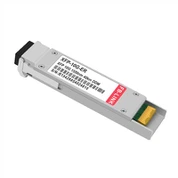
25G BIDI 10KM
25G BIDI 10KM is suitable for 25 Gb Ethernet long-distance applications. 25G BIDI 10KM is divided into 1270nm and 1310nm, which can transmit up to 10km through single-mode optical fiber.25G BIDI 10KM offers a competitive price/performance ratio, reliable quality and stability.

- Product Introduction
Feature
● Hot-pluggable SFP28 form factor
● Supports 9.83/10.13/10.31/24.33/25.78Gb/s bit rate
● Power dissipation <1.2W
● Industrial case temperature range of -40°C to 85°C
● Single 3.3V power supply
● Maximum link length of 10km on Single Mode Fiber (SMF)
● Aligned with IEEE 802.3cc
● 25G DFB transmitter and 25G PIN receiver
● Simplex LC receptacles
● I2C management interface
● RoHS compliant
Compatible
Products Description
| Part Number | SFP28-25G-BX10-U | Distance | 10KM |
| Product type | SFP28 | TX Power | -5.0~+2.0dBm |
| Rate | 25Gb/s | Receiver Sensitivity | <-12.0dBm |
| Connector | Simplex LC | DDM | Supported |
| Wavelength | TX1270/RX1330nm | Temperature Range | 0~70℃ |
Application scenario

Advantage

Price advantage
Factory direct sales, reducing transfer costs and maximizing customer benefits
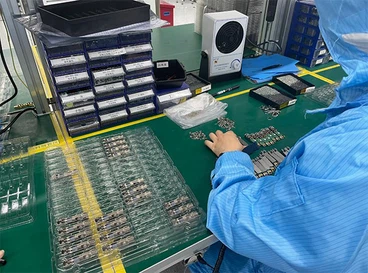
Quality Assurance
Products will undergo multiple process inspections before leaving the factory.

Widely compatible
Widely compatible with switches of various brands

Professional technical support
Continuously introduce new equipment, timely update and solve customer problemstics
Network infrastructure demands continue to escalate as businesses push for faster, more reliable data transmission. Modern optical transceivers have become the backbone of enterprise and data center networks, delivering the bandwidth and performance required for today's data-intensive applications.
Understanding Advanced Optical Transceivers Technology
The evolution of optical transceivers has transformed network capabilities dramatically. These compact modules convert electrical signals to optical signals and vice versa, enabling high-speed data transmission over fiber optic cables. Among the latest innovations, 25G BiDi (bidirectional) optical transceivers represent a significant leap forward in efficiency and performance.
BiDi optical transceivers utilize wavelength division multiplexing (WDM) technology to transmit and receive data simultaneously over a single fiber strand. This innovative approach reduces fiber infrastructure costs while maintaining exceptional performance standards. The SFP28 form factor has become the industry standard for 25 Gigabit Ethernet applications, offering hot-pluggable convenience and widespread compatibility.
Key Advantages of Modern Optical Transceivers
Performance and reliability stand at the forefront of contemporary optical transceivers design. Operating at data rates exceeding 25Gb/s, these modules support the demanding requirements of cloud computing, 5G networks, and high-performance computing environments. The advanced design ensures stable operation even in challenging conditions, with industrial-grade components capable of withstanding extreme temperature variations.
Energy efficiency represents another critical consideration. Premium optical transceivers consume minimal power, typically under 1.2W, reducing operational costs and thermal management challenges. This efficiency doesn't compromise performance-sophisticated DFB (Distributed Feedback) laser technology ensures precise wavelength control and optimal signal quality.
Distance capabilities have also improved significantly. Modern optical transceivers can maintain reliable connections over distances up to 10 kilometers on single-mode fiber, making them ideal for metropolitan area networks and campus deployments. The simplex LC connector interface provides secure, low-loss connections that maximize signal integrity.
Implementation Considerations for Optical Transceivers
Successful deployment of optical transceivers requires careful planning and compatibility verification. Network administrators must ensure alignment with relevant IEEE standards, particularly 802.3cc for 25G Ethernet applications. The I2C management interface enables comprehensive monitoring through Digital Diagnostic Monitoring (DDM), providing real-time visibility into operating parameters such as temperature, voltage, and optical power levels.
Wavelength compatibility is crucial when implementing BiDi optical transceivers. These modules operate on specific wavelength pairs-for instance, transmitting on 1270nm while receiving on 1330nm. Paired transceivers at opposite ends of the link must use complementary wavelength configurations to ensure proper bidirectional communication.
Environmental factors also influence optical transceivers selection. Applications in outdoor cabinets, industrial settings, or locations with temperature extremes require modules rated for extended operating ranges. Quality optical transceivers meet stringent environmental and safety standards, including RoHS compliance for environmental responsibility.
Future-Proofing Your Network Infrastructure
As network demands continue growing, investing in high-quality optical transceivers provides a foundation for scalable infrastructure. The transition from 10G to 25G represents more than simple bandwidth multiplication-it enables new architectures, reduces latency, and supports emerging technologies like artificial intelligence and machine learning applications.
Interoperability remains a cornerstone of effective optical transceivers deployment. Multi-source agreement (MSA) compliance ensures these modules work seamlessly with equipment from various manufacturers, protecting infrastructure investments and providing deployment flexibility. The hot-pluggable design of SFP28 optical transceivers allows for non-disruptive upgrades and maintenance, minimizing network downtime.
Frequently Asked Questions About Optical Transceivers
What is the difference between SFP and SFP28 optical transceivers?
SFP28 optical transceivers are designed for 25 Gigabit Ethernet, offering 2.5 times the bandwidth of standard 10G SFP+ modules. While they share the same physical form factor, SFP28 modules incorporate advanced electronics and optics to support higher data rates. The "28" designation refers to the 25Gb/s data rate plus forward error correction overhead.
How do BiDi optical transceivers reduce infrastructure costs?
BiDi optical transceivers transmit and receive data over a single fiber strand using different wavelengths, effectively cutting fiber requirements in half. This reduces cabling costs, simplifies installation, and decreases the need for fiber management infrastructure. Organizations can achieve significant savings while maintaining full-duplex performance.
What does DDM capability mean for network management?
Digital Diagnostic Monitoring in optical transceivers provides real-time access to critical operating parameters including temperature, supply voltage, transmit power, receive power, and laser bias current. This visibility enables proactive maintenance, rapid troubleshooting, and helps prevent network failures by identifying issues before they impact service.
Can 25G optical transceivers work with existing 10G infrastructure?
While 25G optical transceivers are not directly backward compatible with 10G ports, many modern switches support multi-rate operation. Network equipment with auto-negotiation capabilities can potentially operate 25G transceivers at lower speeds, though this varies by manufacturer. Always verify compatibility with your specific hardware before deployment.
What factors affect the maximum transmission distance of optical transceivers?
Transmission distance depends on several factors including fiber type (single-mode vs. multimode), wavelength, optical budget, and fiber quality. Single-mode fiber supports longer distances due to lower attenuation and dispersion. Link budget calculations must account for connector losses, splice losses, and fiber attenuation to ensure reliable operation at specified distances.
How do I ensure proper wavelength pairing with BiDi transceivers?
BiDi optical transceivers must be deployed in complementary pairs. If one end transmits at 1270nm and receives at 1330nm, the opposite end must transmit at 1330nm and receive at 1270nm. Manufacturers typically designate these as "U" (upstream) and "D" (downstream) variants. Always verify wavelength specifications and pair accordingly to establish successful bidirectional communication.
Hot Tags: Optical Transceivers